Apricot Kernels

Apricot Kernels: Foodservice and Retail Packaging Guide

A practical buyer and exporter guide covering foodservice and retail packaging formats for apricot kernels, including pack size logic, label requirements, private label execution and shipment planning.

Packaging focusFoodservice and retail
Trade focusFormat and labeling
Buyer focusChannel fit
Apricot Kernels: Foodservice and Retail Packaging Guide

Why this topic matters

Apricot kernels can be packed for very different channels, and the right format depends on how the product will actually be sold, handled and consumed.

Apricot kernels can sit in several value chains at once, from ingredient and industrial use to foodservice distribution, specialty retail and private label programs. Because of that, buyers usually need a clearer conversation than simply asking for a price per kilogram. They need to define the kernel type, end use, target market, acceptable appearance, pack style and shipment rhythm before the right commercial offer can be structured properly.

When discussing foodservice and retail packaging, the first question is channel fit. Foodservice buyers usually care about efficient storage, repeated opening and use, durable outer packing, traceable labeling and practical handling in kitchens, bakeries or professional distribution systems. Retail buyers usually care more about shelf presentation, consumer-facing pack size, brand communication, barcode placement, legal label accuracy and whether the packaging supports premium or mainstream market positioning.

Commercially, successful apricot kernel programs are built around timing and specification discipline, but also around packaging logic. Crop timing, carryover structure, pack material choice, carton design, pallet planning, destination requirements and label execution all affect final competitiveness. A supplier conversation becomes much smoother when buyers share annual demand estimates, intended channel, pack size expectation and whether the requirement is for conventional or organic, bulk, foodservice, private label or finished retail sale.

This article helps importers, distributors, foodservice operators and retail brand teams compare packaging approaches before starting a program. It also shows why foodservice and retail packs should not be treated as interchangeable even when the apricot kernels themselves come from the same supply base.
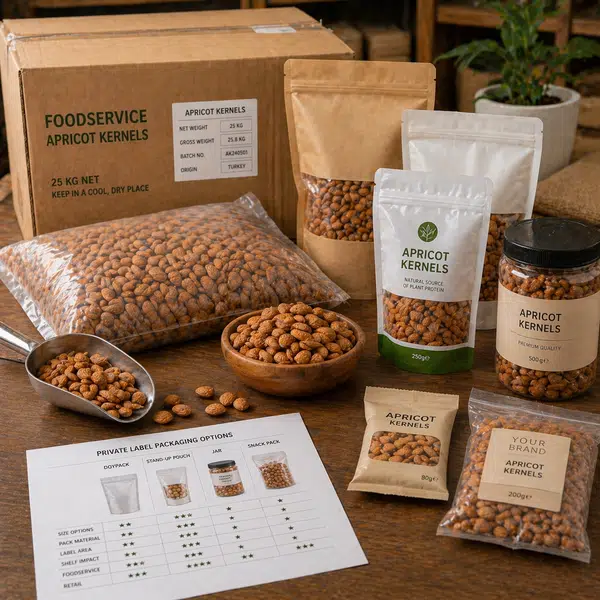
How foodservice and retail packaging differ

The product may be similar, but the packaging logic is usually very different because the operational and commercial objectives are different.

Foodservice packaging

Foodservice packs are usually designed for repeated professional use. Buyers typically focus on handling efficiency, practical storage, reasonable pack size, strong secondary packaging and labeling that supports internal traceability and back-of-house operations.

Retail packaging

Retail packs are designed for consumer purchase and shelf presentation. The priorities usually include visual appeal, consumer convenience, accurate on-pack communication, barcode placement, pack integrity and fit with the target price point or premium positioning.

Private label retail execution

Private label retail packaging adds further complexity because artwork, claims, label hierarchy, language requirements and final presentation all need to match the customer brand and market expectations precisely.

Hybrid formats

Some buyers use intermediate formats, such as plain inner packs for local relabeling or semi-finished consumer units packed in export master cartons. These formats can be useful when flexibility is needed across multiple markets.

Main foodservice packaging considerations

Foodservice buyers usually buy apricot kernels for professional kitchens, bakeries, catering, pastry operations or distribution into non-retail channels, so practicality is central.

Usable pack size

The pack should match the buyer's consumption rhythm and storage pattern. Packs that are too small create inefficiency, while packs that are too large may create operational inconvenience after opening.

Easy warehouse handling

Foodservice buyers usually care about carton strength, stacking performance, pallet practicality and whether the goods move easily through professional receiving and storage systems.

Back-of-house labeling clarity

Labels should remain easy to identify in storage and after receipt, especially for buyers managing several ingredients in professional production environments.

Repeated-use practicality

Foodservice packaging should work under repeated opening and handling conditions, not only during initial shipment. This affects both inner pack logic and case design.

Bulk efficiency

Many foodservice programs prioritize cost-efficient larger formats because the product is not sold directly in consumer units. Packaging should reflect that commercial reality.

Product protection in operations

The pack should be strong enough not only for transit, but also for internal movement within warehouses, kitchens, bakeries or distribution centers after arrival.

Main retail packaging considerations

Retail packaging must function as both protective material and a commercial communication tool.

Consumer pack size logic

The pack size should fit the intended market segment, price point and usage expectation. Premium small packs, mainstream everyday packs and specialty health-oriented packs may all need different size logic.

Shelf-facing presentation

Retail buyers usually care about how the pack looks in-store and online. Shape, clarity of branding, front-panel communication and overall presentation influence market acceptance.

Label hierarchy and claims

Retail packs usually need more detailed and more carefully structured labeling than foodservice packs because the consumer sees the product directly and the legal communication burden is higher.

Barcode and coding discipline

Retail execution generally requires clearer barcode logic, date coding visibility and consistency across repeated runs, especially for larger retail chains or private label customers.

Master carton compatibility

Even retail-ready units need strong secondary packaging for export. The outer-case structure should protect the finished packs without compromising retail presentation at destination.

Private label readiness

Where the buyer operates under retailer or brand-owned labeling, the supplier may need to support packaging files, layout approval, technical alignment and repeated production consistency.

How packaging format affects commercial structure

Packaging decisions do more than change appearance. They influence cost, freight performance and the overall operational model of the program.

Smaller retail units: These usually increase packaging material cost per kilogram, coding complexity, approval work and label management. They may also reduce freight efficiency compared with larger industrial or foodservice packs, but they create a finished product ready for sale.

Larger foodservice packs: These generally improve material efficiency per kilogram and often support better freight economics, but they are only appropriate when the buyer's channel can handle and use them practically.

Outer-case design: The strength, dimensions and stacking behavior of the master carton matter for both foodservice and retail programs. Poor outer-case design can reduce arrival quality and operational efficiency even if the inner pack looks acceptable.

Pallet planning: Packaging format influences how many cartons fit per pallet, how stable the load becomes and how efficiently the shipment uses container space. This has real commercial impact, especially for repeated export programs.

Approval workload: Retail and private label packs usually involve more label review, artwork control and specification management than foodservice formats. Buyers should treat that as part of the commercial scope, not as an afterthought.

Choosing the right packaging model

The best format depends on who will open the pack, how often it will be handled and whether the product is sold directly to consumers or used in professional settings.

When foodservice formats make more sense

Foodservice packaging is usually the better choice when the customer values operational efficiency, repeated professional use, lower packaging cost per kilogram and stronger bulk practicality over shelf-facing presentation.

When retail formats make more sense

Retail packaging is usually the better choice when the customer wants a finished consumer product with brand communication, price-point control and direct store or e-commerce readiness.

When semi-finished formats are useful

Some importers prefer to receive plain or partially finished units that allow local language adaptation, local sticker application or more flexible final-market execution after import.

When one buyer needs multiple formats

Distributors and mixed-channel businesses may need both foodservice and retail structures from the same product family. In those cases, the pack logic, grade logic and documentation flow should be separated clearly from the start.

Common mistakes buyers make with packaging programs

Many packaging problems begin with channel mismatch or incomplete briefing rather than with poor product quality.

Using retail logic for foodservice buying

Some buyers request small consumer-style packs even though their channel would work better with a more efficient professional-use format.

Using bulk logic for visible retail programs

Retail success usually depends on stronger consumer presentation and label discipline than bulk export structures are designed to provide.

Finalizing label decisions too late

Late artwork, barcode or wording changes often disrupt otherwise workable retail or private label packaging programs.

Ignoring the impact of master cartons

Even beautifully designed retail units can underperform if the outer-case structure is weak and the shipment arrives in poor physical condition.

Not matching the pack to storage reality

A format that looks commercially attractive may still fail if it does not suit the buyer's warehouse space, shelf plan or professional handling pattern.

Treating packaging as a minor add-on

Packaging is part of the commercial product definition. When it is discussed too late, quotation accuracy and shipment readiness both weaken.

What buyers should define before requesting a quotation

A clear packaging brief produces a much stronger and more realistic commercial offer.

Channel brief

Confirm whether the product is for foodservice, retail, private label, local repacking or a mixed sales model.

Product brief

State kernel type, intended use, organic or conventional status and the target market the packs are being built for.

Pack-size brief

Define the desired unit size, case structure and whether the objective is consumer sale, professional handling or intermediate import format.

Label brief

For retail and private label programs, provide brand, language, barcode, claim and coding expectations as early as possible.

Outer-pack brief

Share carton, liner, pallet and shipping expectations so the supplier can match the secondary packaging to the route and handling reality.

Program brief

Clarify whether the request is for samples, a trial order, a recurring order cycle or a longer annual supply program with repeat packaging execution.

Key takeaways

These points make the article immediately useful for importers, distributors, foodservice buyers and retail brand teams.

Foodservice and retail packs solve different problems

Foodservice packaging focuses on professional handling and efficiency, while retail packaging focuses on consumer presentation and finished market readiness.

Packaging affects the real commercial cost

Pack format changes material usage, pallet density, freight economics, approval effort and overall supply complexity.

Retail programs need stronger label discipline

Artwork, barcode, coding and consumer-facing communication usually require more careful alignment than foodservice packs.

Foodservice programs need operational practicality

The pack should work well in storage, handling and repeated use, not simply during initial export shipment.

Master cartons matter in both channels

Outer-case quality influences arrival condition, pallet stability and total execution quality regardless of what the inner pack looks like.

Better briefs create better quotations

When buyers define channel, pack size, label logic and outer-case expectations clearly, suppliers can quote more accurately and with less operational risk.

Commercial discussion checklist

A structured checklist helps buyers and suppliers move from a general packaging inquiry to a workable export-ready format.

Channel brief

Confirm whether the format is for foodservice, retail, private label or local repacking after import.

Product brief

State kernel type, intended use, organic or conventional status and the target market profile.

Unit-pack brief

Share required pack size, pack material style and whether the product must be shelf-ready or back-of-house practical.

Label brief

For retail and private label lines, define branding, language, barcode, claim and coding expectations early.

Outer-pack brief

Define carton, liner, pallet and shipment-handling requirements so the export pack is built around real logistics needs.

Program brief

Indicate whether the request is for a trial run, recurring order flow or a broader annual program requiring repeat packaging consistency.

Mini FAQ

Short answers on apricot kernel foodservice and retail packaging programs.

What should buyers clarify first for apricot kernels?

Buyers should first clarify kernel type, end use, target market, desired grade, certification profile, required pack format and whether the program is for foodservice, retail or private label.

Why create a separate article for foodservice and retail packaging guide?

Because foodservice and retail programs require different packaging logic. Foodservice usually prioritizes handling efficiency, pack durability and back-of-house practicality, while retail focuses more on shelf presentation, label communication, consumer pack size and private label execution.

Can this topic support both organic and conventional programs?

In many cases yes, provided the kernel type, certification profile, packaging flow and labeling structure are aligned with the customer requirement and the available sourcing program.

What is the main packaging difference between foodservice and retail?

Foodservice packaging is usually built around storage efficiency, repeated use and operational practicality, while retail packaging is usually built around consumer presentation, shelf impact, labeling accuracy and finished brand communication.

Why does packaging affect commercial planning so much?

Because pack format changes material cost, pallet efficiency, freight economics, labeling scope, approval work and the overall suitability of the product for the intended market channel.

Can one program use both foodservice and retail formats?

Yes. Some buyers operate mixed-channel models, but the pack structure, labeling logic and commercial calculation should be separated clearly for each channel from the beginning.

Quick Contact