Buyer profile
Suitable for importers, distributors, organic retail brands, snack manufacturers, bakery users, ingredient blenders and industrial food processors.
Atlas Global Trading Co. supports importers, organic wholesalers, premium brands, industrial users and private label buyers with export-ready organic dried fruit programs built around origin reliability, specification discipline, certification alignment and commercially practical execution.
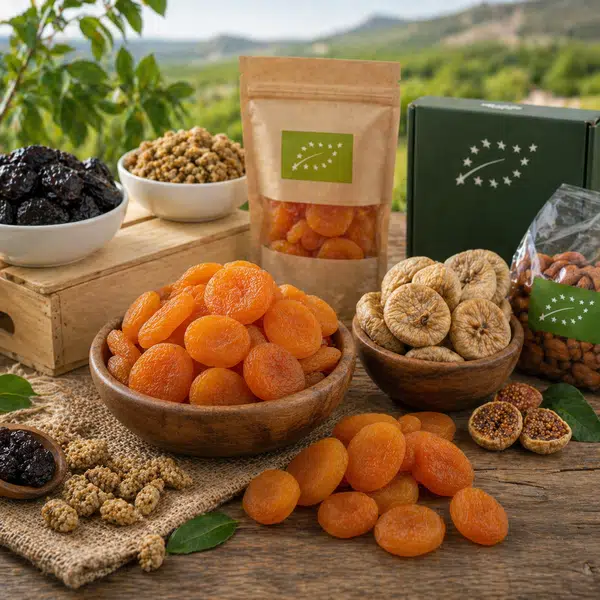
Our organic portfolio is structured for buyers who evaluate more than just the product name. The discussion usually includes crop origin, processing discipline, organic certification status, physical specification, microbiological profile, residue sensitivity, packing logic, traceability expectations and the commercial ability to deliver consistently across trial, repeat and programmed business.
Suitable for importers, distributors, organic retail brands, snack manufacturers, bakery users, ingredient blenders and industrial food processors.
Available across bulk export cartons, industrial formats, foodservice packs and selected private label retail-ready programs subject to product and market fit.
Built around long-term supply compatibility, clear product positioning, realistic specifications and operationally workable documentation support.
The products below represent the main organic categories most frequently discussed with international B2B buyers. Final specification, pack style and shipment structure are aligned to crop conditions, market requirements and intended end use.
A flagship Turkish origin product for buyers looking for authentic organic positioning, natural appearance and category depth. Suitable for retail, snack, ingredient and further processing channels.
Typical specification framework: no additives, sun-dried, moisture max. 24% depending on grade and agreement, water activity around 0.70, E. coli max. 1000 cfu/g, yeast & mold max. 10,000 cfu/g, aflatoxin B1 < 5 ppb, total aflatoxin < 10 ppb, Salmonella absent in 25g, non-GMO, pesticide compliance subject to organic program and destination market controls.
Organic Turkish figs remain a strategic category for brands and distributors that value Mediterranean origin identity, naturally sweet profile and strong relevance in premium snacking and bakery applications.
Typical specification framework: moisture max. 24% depending on product style, water activity around 0.70, E. coli max. 1000 cfu/g, yeast & mold max. 10,000 cfu/g, aflatoxin B1 < 5 ppb, total aflatoxin < 10 ppb, non-GMO, physical sorting and quality review based on style, size and destination requirements.
Organic mulberries offer a distinctive product story for buyers looking to expand beyond mainstream dried fruit items. They work well in premium health-focused assortments, mixes and natural snacking concepts.
Typical specification framework: sun-dried, cleaned and selected, aflatoxin B1 < 5 ppb, total aflatoxin < 10 ppb, water activity around 0.70, yeast & mold max. 10,000 cfu/g, non-GMO, final physical and microbiological standards subject to program structure and intended use.
Organic prunes complement the broader organic fruit basket for buyers who need a dependable high-volume dried fruit category with familiar demand across retail and ingredient markets.
Typical specification framework: washed and graded dried plums, no additives unless otherwise agreed for application-specific formats, moisture around 25% max depending on type and size, non-GMO, physical and microbiological criteria finalized per product style and destination market.
Organic apricot kernels are handled as a more technical product category and are generally discussed in relation to end use, quality parameters, documentation expectations and application-specific suitability.
Typical specification framework: selected kernels, physical sorting subject to grade, application-specific quality criteria, non-GMO, documentation and final technical review according to intended use, regulatory context and destination market expectations.
In addition to core single-product requests, Atlas can support buyers who want to build or expand an organic dried fruit basket through one communication channel and one commercially coherent sourcing discussion.
Typical program scope: mixed-product quotations, crop-window alignment, pack-format review, destination document planning, private label coordination, sample scheduling and supply continuity discussion across more than one organic category.
Serious organic purchasing decisions are rarely based on price alone. Buyers typically review the full technical and commercial picture before approving a supplier or confirming a shipment program.
Organic certification status, operator traceability, product identity preservation and market-specific organic expectations are central to the discussion.
Depending on the category, buyers may review microbiological limits, mycotoxin sensitivity, residue discipline and general food safety suitability.
Size, moisture, appearance, texture, defect tolerance, sorting level, foreign matter control and uniformity all affect suitability and price positioning.
Retail snack, bakery, confectionery, breakfast, ingredient, foodservice and industrial uses all require different handling and pack logic.
Carton size, inner packaging, labeling architecture, pallet efficiency and transit stability matter in export economics and downstream handling.
Repeatability, crop visibility, commercial responsiveness and realistic lead-time communication are essential for stable organic programs.
The value of an organic range page is not only to show products. It should also help procurement, category, technical and brand teams understand why the supplier is commercially workable.
Organic dried fruits can also serve as dependable raw materials for cereal, bar, bakery, confectionery, dairy inclusion, blending and ingredient manufacturing applications. In these cases, the commercial focus usually shifts toward cut style, processing suitability, microbiological stability, packing efficiency, consistency and total delivered cost.
Organic product supply must be commercially attractive and operationally practical. Atlas structures discussions around the most relevant shipping and packing routes for the buyer's channel.
Suitable for importers, repackers, ingredient processors and large-volume users seeking container-based supply and downstream conversion flexibility.
Relevant for hospitality distributors, institutional suppliers and professional kitchen channels requiring practical pack sizes and dependable repeat sourcing.
Retail-facing projects can be reviewed based on MOQ, artwork readiness, packaging style, label language, market compliance and program scale.
Strong organic supply is not just a sourcing issue. It also depends on how clearly product requirements are defined, how early destination needs are communicated, and how efficiently the shipment plan, documents and packing structure are organized.
Final document availability depends on the product, market, certification route and shipment structure, but buyers typically expect a supplier to be prepared for the documentation conversation from the beginning.
Documentation quality affects customs handling, importer confidence, internal buyer approval, retailer onboarding, technical review and repeat business. Good document preparation reduces friction and supports faster decision-making.
Turkey remains strategically relevant in organic dried fruit because of product heritage, category reputation, deep grower and processor ecosystems, and the commercial relevance of origins such as Malatya for apricots and Aydın for figs.
Strong international familiarity with Turkish apricots and figs supports category credibility and brand communication.
The Turkish dried fruit base enables both hero products and broader portfolio building for importers and distributors.
Origin familiarity, export experience and diversified buyer use cases make Turkey commercially significant for organic dried fruit sourcing.
Buyers in organic categories often compare multiple suppliers that can all offer a certificate. The real difference is usually in responsiveness, technical clarity, realistic commitments and operational follow-through.
Clear communication around realistic technical parameters avoids misunderstandings, claim risk and pricing distortion.
Projects move faster when buyers receive practical answers on availability, pack options, MOQ logic, lead times and route suitability.
Long-term buyers usually prefer a supplier that can support continuity, not only one-off opportunistic offers.
A structured inquiry process helps shorten the path from first contact to quotation, sample review and supply discussion.
We review the product, target market, volume expectation, pack style and timing.
Key quality and compliance points are clarified before quotation or sample planning.
Pricing logic, pack structure, MOQ assumptions and shipment basis are discussed.
Sample, documentation and order planning move forward where mutual fit is confirmed.
The following points summarize what many buyers want to confirm before moving into a product-specific conversation.
Yes. Atlas supports both certified organic programs and conventional supply structures depending on the category and market.
Yes, where the product, MOQ, packaging format, market route and timeline are commercially feasible.
Yes. Many organic products can be structured for ingredient or manufacturing use subject to the required format and technical profile.
Share the product, expected volume, pack style, target market and whether the project is trial-based, seasonal or program-based.
A useful inquiry usually includes the product, organic requirement, expected volume, pack format, destination market, target channel and any technical points that could affect suitability. The more precise the brief, the more commercially relevant the response.
Well-defined inquiries help reduce unnecessary back-and-forth and make it easier to provide a quotation structure, product recommendation, sample path or supply feasibility assessment that matches the actual project.