Visual differentiation
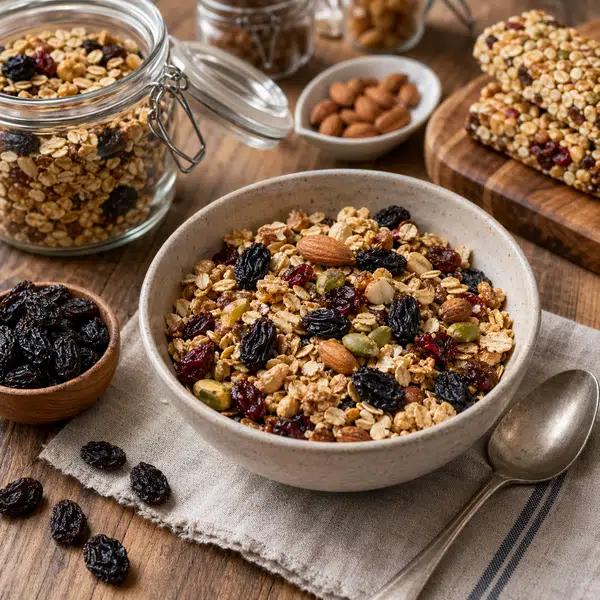
Their darker color creates contrast in granola, muesli and trail mixes, helping products look more premium and more visually layered.
A practical B2B guide for cereal manufacturers, granola producers, snack blenders, repackers and ingredient buyers evaluating black raisins as a functional and visually differentiated fruit ingredient. This article focuses on technical fit, blend performance, packing logic and commercial sourcing points that matter in real breakfast and snack mix production.
Breakfast cereals and snack mixes require ingredients that do more than taste good. They must also blend, flow, store and present well in a complex multi-ingredient system.
Black raisins can sit in several value chains at once, from premium retail snack packs and trail mixes to granola, cereal clusters, breakfast blends and fruit-and-nut assortments. Their darker appearance and stronger visual identity can make them commercially attractive where buyers want more contrast and a more premium fruit profile than standard lighter raisins.
In breakfast and snack mixes, black raisins are usually judged on more than sweetness alone. Buyers look at berry size, flowability, clumping tendency, moisture behavior, visual impact, mix stability and how well the ingredient performs with oats, flakes, nuts, seeds, crisp inclusions and other dried fruits. For that reason, the right sourcing conversation must go beyond generic dried fruit pricing and focus on actual application requirements.
When discussing black raisins for industrial applications in breakfast and snack mixes, the first question is application fit. A granola producer may care most about distribution in the blend, visual contrast and resistance to excessive clumping. A cereal manufacturer may focus on line feeding, moisture stability and how the ingredient performs through packing and storage. A snack mix brand may place greater emphasis on appearance, berry count and consumer perception of premium fruit content.
Commercially, strong programs for black raisins are usually built around specification discipline, blend performance and consistency of supply. Crop timing, sorting level, grade mix, packaging route, destination requirements and documentation all affect final competitiveness. A supplier discussion becomes much more productive when buyers explain the intended product type, expected annual volume, pack format, target market and whether the project is conventional, organic or label-sensitive.
Black raisins are commercially useful in this category because they combine fruit sweetness, chew, visual contrast and familiar consumer acceptance.
Their darker color creates contrast in granola, muesli and trail mixes, helping products look more premium and more visually layered.
Black raisins can support sweetness and fruit character without relying entirely on added flavor systems, especially in better-for-you or fruit-led snack concepts.
They add chewiness and softness to mixes that would otherwise be dominated by dry, crisp or crunchy components, improving eating experience.
Breakfast and snack mix products are often sold on visual appeal as much as ingredient logic. Black raisins can make a mix look richer and more premium while still remaining commercially familiar enough for broad-market use. That makes them attractive for both mainstream and differentiated product development.
Black raisins are flexible, but each application category places different demands on the ingredient.
In granola and baked breakfast systems, black raisins often add chew, fruit sweetness and visual contrast. Buyers usually consider whether the fruit is added before or after baking, and whether the product needs a more robust berry profile to remain visually distinct.
In muesli and cereal applications, distribution, moisture balance and berry count per serving become important. The ingredient must mix evenly and remain commercially attractive through packing and shelf life.
In trail mixes, black raisins are often used to add darker fruit character and premium visual variety alongside nuts, seeds, sultanas, cranberries and other dried fruits.
In ready-to-eat snack formats, appearance and berry integrity become especially important because the consumer sees the ingredient directly and judges quality immediately.
A raisin that works well in an industrial granola base may not be ideal for a clear-window retail snack pouch. Likewise, a fruit that looks strong in a premium trail mix may not be the most cost-effective option for a value-positioned cereal blend. Strong buying decisions therefore begin with the exact product concept, not with the fruit name alone.
In breakfast and snack systems, black raisins must perform well both as an ingredient and as part of a larger blend architecture.
In industrial mixing applications, small technical differences can create major commercial consequences. Fruit that is too sticky may create clumping or poor distribution. Excess size spread can distort the visual balance of the mix. Poor sorting can reduce consumer confidence in transparent or window-packed products. Moisture imbalance may also affect adjacent ingredients such as crisp cereal, nuts or seeds.
Moisture is one of the most important technical variables in breakfast and snack applications. Fruit that is too dry may feel hard and less attractive in premium mixes. Fruit that is too moist may reduce flowability, encourage clumping and affect overall blend stability. Buyers usually perform best when they define a realistic moisture and texture direction that reflects the actual product system rather than relying on a generic dried fruit assumption.
Each breakfast or snack format creates its own balance of quality, cost and functionality.
Usually require fruit that remains visually distinct, avoids excessive clumping and supports a premium artisan-style look in the final blend.
Often prioritize even dispersion, manageable moisture and commercially stable count per portion or pack weight.
Usually place greater emphasis on consumer-facing appearance, berry integrity, color contrast and the overall balance of the fruit with nuts and other inclusions.
A black raisin profile that is ideal for a bulk granola base may not be ideal for a premium stand-up pouch snack mix. Product concept, price point, visual expectations and blend complexity all influence the right grade and packing route. That is why the intended breakfast or snack format should be the starting point of any commercial discussion.
These categories are often judged visually by the consumer, so ingredient appearance can matter almost as much as process functionality.
These usually focus on consistency, flowability, manageable moisture, clean sorting and stable performance during blending and filling.
These typically add stronger requirements for berry integrity, uniform appearance, visual contrast, piece count balance and final pack attractiveness.
Two black raisin offers may both be technically usable, but one may be better suited to industrial breakfast blends while the other is more suitable for visible premium snack packs. Buyers that separate general fruit acceptability from actual application performance usually achieve better outcomes and fewer complaints after launch.
The right packing route depends on whether the buyer is blending industrially, repacking locally or selling finished branded snack products.
Bulk export or ingredient-style cartons are usually the preferred route for cereal plants, granola manufacturers and snack mix blenders that need operational efficiency and repeat manufacturing supply.
When the product is being sold directly in finished breakfast or snack packs, the discussion may include pouch formats, stand-up bags, multi-pack logic, label claims and retail shelf presentation.
Industrial buyers usually benefit from packs designed for efficient blending and storage, not for shelf aesthetics. Retail snack brands usually need the opposite. Making that distinction early helps avoid unnecessary cost and keeps offers aligned with the real business model.
In this category, the right ingredient can affect not only production efficiency but also final shelf appeal and repeat sales performance.
The fruit must deliver visual and sensory value without making the final mix commercially too heavy or too costly relative to the market position.
Brands and manufacturers usually need consistency in berry profile and blend performance across multiple orders, not just one successful first run.
In visible mixes, ingredient quality is often judged immediately by color, size and distribution. Black raisins can raise value perception if the quality is aligned correctly.
Breakfast and snack brands usually perform better when supply is organized as a recurring program rather than purely reactive spot buying. This improves continuity, supports formulation stability and makes it easier to align price, quality and packing decisions across a longer commercial horizon.
These points make the article immediately useful for importers, processors and brand teams.
Key decision point: define the exact breakfast or snack application before selecting grade, moisture target and packing route.
Common buyer need: align berry size, flowability, clumping control and visual expectations before benchmarking price.
Supply planning note: product suited to visible premium snack mixes may require tighter control than product intended for broad industrial blending.
Commercial tip: recurring breakfast and snack programs usually perform better when they are built around stable functionality and blend consistency, not only lowest spot price.
A short checklist helps buyers and sellers move faster toward a practical quotation and better application fit.
Confirm application type, desired berry profile, moisture direction, visual expectations and whether the fruit will be blended into cereal, granola, muesli or snack packs.
Share whether the requirement is industrial bulk, ingredient handling, retail-ready pouching or a private label breakfast or snack launch.
State whether the inquiry is for trials, pilot runs, recurring production demand or a commercial consumer product rollout.
A strong first message usually includes the target product format, annual or trial volume, preferred berry profile, pack route, destination market and any important quality or certification requirements. This makes it much easier to identify the right black raisin profile for the intended mix.
Short answers on every article help buyers review the topic quickly.
End use, target market, desired grade, moisture profile, required certification status and preferred pack format should be clarified first.
Because cereal blends, granola, trail mixes and snack packs each require different assumptions on size consistency, moisture behavior, flowability, clumping control, visual impact and consumer-facing quality.
In many cases yes, provided the fruit, certification profile, technical requirements and available sourcing program are aligned with the buyer requirement.
Typical applications include granola, muesli, breakfast cereals, trail mixes, fruit-and-nut snack blends, portion-controlled snack packs and premium mixed dried fruit assortments.