Crop size and usable yield
Overall harvest volume matters, but usable export-grade yield matters more. A season may look large on paper while still producing fewer commercially attractive lots in the grades buyers actually want.
A practical B2B guide for importers, distributors, repackers, industrial users and private label teams evaluating black raisins from a pricing and risk-management perspective. This article explains what actually moves price, what creates hidden commercial exposure and how buyers can compare offers more intelligently.
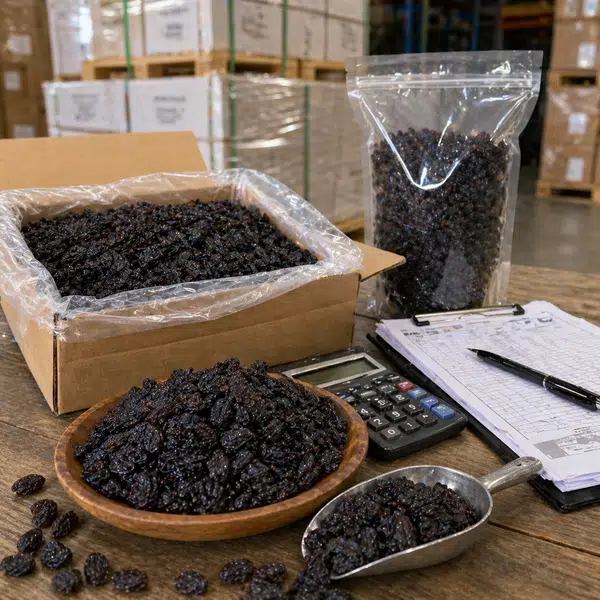
Black raisin price is not just a crop number. It is the result of product quality, pack structure, logistics, timing and commercial requirements combined.
Black raisins can sit in several value chains at once, from premium retail and branded snack formats to bakery, breakfast cereal, confectionery and ingredient applications. Because they often carry a more distinctive visual character than standard sultanas, buyers frequently compare them on more than just commodity value. Appearance, size distribution, moisture behavior, processing suitability, packing route and destination expectations all influence the real buying decision.
For that reason, buyers usually need a clearer conversation than simply asking for a price per kilogram. They need to define the end use, target market, acceptable appearance, grade direction, shipment rhythm, pack structure and whether the requirement is for bulk, private label, repack or industrial use. Only then can offers be benchmarked in a meaningful way.
When discussing black raisins for price drivers and commercial risk factors, the first question is application fit. Bakery and confectionery users often care about size consistency, moisture control, cutting behavior and total delivered functionality. Retail buyers may care more about berry appearance, consumer-facing pack quality, label claims and shelf presentation. Importers and repackers may prioritize pallet efficiency, sorting reliability, landed-cost control and flexibility after arrival. Each of these changes the price structure.
Commercially, successful black raisin programs are usually built around timing discipline, realistic quality alignment and careful risk control. Crop conditions, grade mix, carryover stock, container planning, packaging costs, destination requirements, documentation quality and payment structure all affect final competitiveness. A supplier conversation becomes much smoother when the buyer shares annual demand estimates, pack format, intended channel and critical technical requirements from the beginning.
Understanding the main price variables helps buyers compare offers on substance rather than headline numbers alone.
Overall harvest volume matters, but usable export-grade yield matters more. A season may look large on paper while still producing fewer commercially attractive lots in the grades buyers actually want.
Larger, more uniform berries with stronger visual appeal, lower defect tolerance and better sorting usually carry a higher price than broader industrial-style lots.
Product that is better aligned to a specific end use, whether retail, repack or industrial processing, may justify a higher price because it reduces losses, complaints or downstream handling issues.
The degree of preparation, foreign matter control, stem management and final presentation directly affects labor, yield and final commercial quality.
Bulk export, industrial packs and private label retail formats do not carry the same cost structure. Packaging materials, finished-goods labor and pack complexity can materially change the offer level.
Freight conditions, container availability, delivery urgency, shipment season and destination route exposure all influence final commercial viability.
Some price differences come from the fruit itself, long before freight and documentation are added.
Better-looking and more uniform black raisins may cost more, but they can reduce rejection risk, lower repacking waste, improve shelf presentation and support higher final selling prices. Lower-priced lots may still be commercially valid for industrial or less appearance-sensitive uses, but only when the application is aligned correctly.
A low headline price may reflect broader size spread, lower visual quality, looser sorting, higher expected waste, less flexible packing, shorter shelf presentation value or more limited documentation support. Buyers that compare only nominal unit price without comparing usable commercial quality often underestimate the real total cost.
The same black raisin category can price differently depending on whether it is bought for bulk import, industrial use or finished retail sale.
These routes usually prioritize landed-cost efficiency, pallet density, process suitability and repacking or manufacturing flexibility. Buyers in this segment often accept broader appearance ranges if the product performs well operationally.
These routes usually require tighter appearance discipline, label-ready packaging, more defined pack control, market-facing presentation and more coordination around compliance and finished-goods execution.
Carton efficiency, sorting level, industrial suitability, shipment scale and repack flexibility.
Packaging materials, finished-case handling, artwork coordination, label requirements and retail presentation quality.
Some buyers use bulk for industrial or repack channels and private label for selected SKUs, creating two price structures within one program.
Timing can change both available quality and the commercial confidence behind an offer.
Black raisin pricing often moves with the seasonal information cycle. Before the crop is fully commercialized, the market may react to expectations and early signals. Once usable quality and grade mix become clearer, price discussions tend to become more structured. Later in the season, remaining inventory, carryover stock quality and continuity concerns can shape the market differently again.
Buyers that start discussions early may gain better visibility and stronger access to preferred grades, but they may also need to accept that some variables are still being defined. Buyers that wait for more clarity may gain better visibility on actual quality, but they may also face tighter availability if the best lots are already committed.
Planning is possible, but hard pricing may be less stable.
Offers begin to reflect actual crop reality, but allocation can move quickly.
Usually the strongest period for structured program execution and replenishment planning.
Inventory profile, remaining grade mix and continuity risk become more important.
Risk in dried fruit trade is not only price risk. It also includes quality mismatch, timing failure and documentation or execution problems.
One of the most common commercial mistakes is trying to compare offers that are not based on the same actual requirement. If one offer assumes broader industrial quality and another assumes tighter retail presentation, the price gap may look large even though the offers are not truly competing against each other. Clear specification alignment is often the simplest way to avoid avoidable risk.
Final competitiveness depends not only on product price but on how efficiently it can be packed, shipped and received.
Ocean freight, inland transport and container availability can materially change delivered pricing, especially on lower-margin or bulk-heavy programs.
Packaging material cost, especially in private label, can affect offers as much as minor product price changes in the fruit itself.
Inefficient pack design can reduce container productivity and raise the real landed cost even if the nominal ex-works fruit price looks attractive.
Smart buyers usually compare landed usefulness, not just ex-works price. A slightly higher product price can still be the better choice if it delivers stronger pack efficiency, lower waste, better retail presentation, smoother customs handling or fewer complaints after arrival.
Most avoidable risk can be reduced before pricing is even requested.
Retail, industrial, repack and private label programs need different quality and packing assumptions.
Grade, appearance, pack format, target market, documents and volume should be defined before price comparison.
Annual or recurring structures often reduce disruption and improve negotiation quality compared with purely reactive spot buying.
These points make the article immediately useful for importers, processors and brand teams.
Key decision point: define whether black raisins are for industrial, retail, repack or private label use before benchmarking price.
Common buyer need: align grade, moisture, appearance profile and pack format before comparing supplier offers.
Supply planning note: price can move with crop visibility, grade availability, packing route and shipment timing, not only with raw harvest size.
Commercial tip: the safest buying decisions usually come from clear specification discipline and recurring program thinking rather than one-off price chasing.
A short checklist helps buyers and sellers move faster toward a practical quotation and more reliable risk assessment.
Confirm format, grade, visible quality expectations, intended end use and whether the fruit will be sold as-is or processed further.
Share carton, bag, pallet, retail pack, labeling and private label expectations as early as possible.
State whether the inquiry is for a trial, recurring order, annual contract, repacking model or retail launch.
A strong first message usually includes the target market, intended application, preferred quality level, pack structure, expected annual volume, shipment timing and whether the project is spot-based or continuity-focused. This makes it much easier to separate real pricing issues from preventable commercial misunderstandings.
Short answers help buyers review the topic quickly before opening a supply discussion.
End use, target market, desired grade, required certification profile, expected annual volume and preferred pack format should be clarified first.
Because price in black raisins is influenced by more than crop size alone. Grade, appearance, pack route, logistics, documentation, timing and application fit all shape the real commercial result.
In many cases yes, provided the fruit, certification profile, quality expectations and sourcing route are aligned with the buyer requirement and the available program.
Because they may not be based on the same actual requirement. Differences in grade, visual profile, sorting, packing, documentation support, timing and delivery structure can all materially change price.