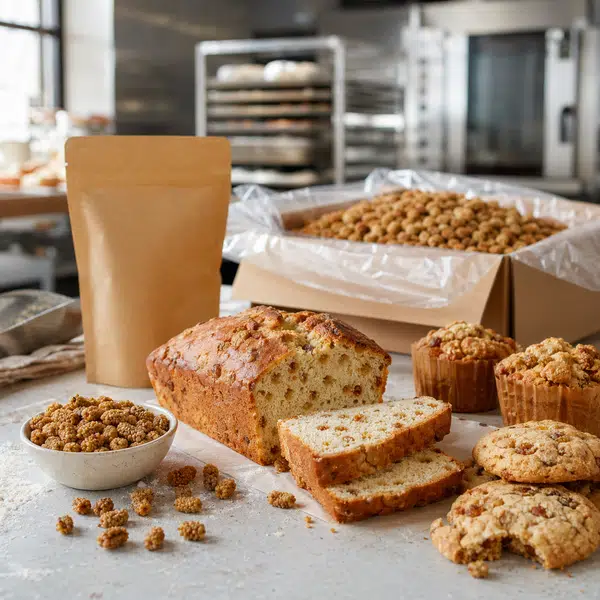
Dried mulberries can serve several bakery channels at once, from premium artisanal products to structured industrial lines. Their naturally sweet profile, relatively light chew, pale-to-golden appearance and specialty-fruit positioning make them relevant for bakers looking to differentiate recipes without relying only on more common dried fruit options. In bakery, however, product suitability is not defined by appearance alone. Buyers need to assess whether the fruit is appropriate for dough systems, deposited batters, inclusions, toppings, fillings or post-bake decoration.
For this reason, a serious bakery inquiry goes beyond asking for a kilogram price. Industrial buyers usually need to define end use, cut or whole format preference, target moisture style, visible quality expectations, process step, dosage level, pack format and commercial program structure before the right quotation can be prepared. A fruit that works well in a retail snack pack may not behave the same way in a cookie dough, soft cake matrix or cereal bar line.
In bakery applications, dried mulberries are typically evaluated for size consistency, moisture balance, mixing tolerance, bake stability, sweetness contribution, visual retention after processing and the risk of excessive breakage or sticking. The practical question is not only whether the fruit tastes good, but whether it performs consistently in the chosen manufacturing environment while still supporting the desired product positioning.
Commercially, dried mulberry programs become more efficient when buyers define whether the requirement is for conventional or organic supply, whether the product will be used as a visible premium inclusion or as part of a cost-controlled ingredient system, and whether the program is trial-based, seasonal or annual. Good specification discipline usually reduces quotation delays, sampling confusion and supply mismatches.