Seasonality shapes supply
Dried mulberries are closely linked to the harvest cycle, so annual planning usually works better than purely opportunistic spot buying.
A practical buyer guide covering dried mulberry seasonality, harvest windows and crop planning, with focus on annual supply timing, quality variation, stock strategy, commercial forecasting and sourcing discipline.
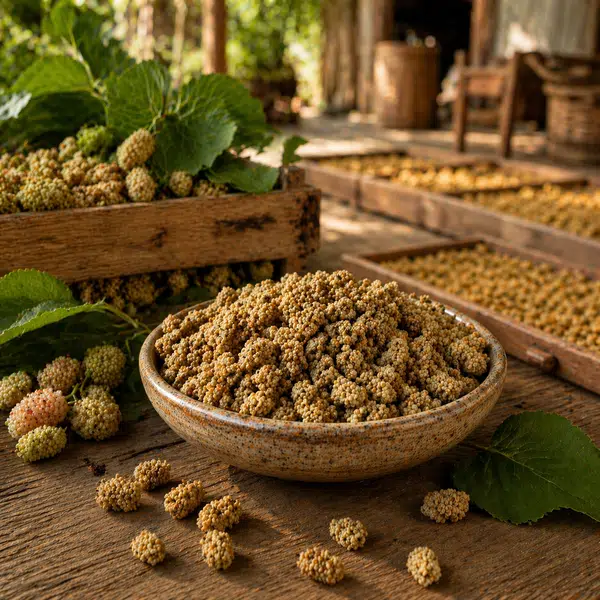
Dried mulberries are a seasonal agricultural product, so successful sourcing depends on timing as much as on product specification.
Dried mulberries offer a naturally sweet profile, a lighter eating character and a category position that fits organic, wellness, breakfast, snacking and ingredient channels. They can serve premium retail packs, cereal and granola blends, snack mixes, natural food ranges and selected industrial applications. Even so, dried mulberries are not a product that should be discussed only in terms of spot price. Their commercial reliability depends heavily on harvest timing, post-harvest selection, available stock depth and how early the buyer starts planning.
Compared with some more standardized dried fruit categories, dried mulberries can show stronger seasonal character. Crop timing, weather during the harvest period, field and orchard conditions, drying performance, sorting losses and pack-out quality can all influence the usable commercial profile from one season to the next. Buyers who understand this are usually able to plan more effectively, secure more suitable quality and avoid rushed purchasing decisions late in the cycle.
The most important commercial point is that crop planning affects more than availability. It also affects grade consistency, organic versus conventional allocation, pack scheduling, shipment windows and the ability to support repeat programs. If a buyer waits until inventories are already tightening, the discussion often becomes narrower and less flexible. If the program is defined earlier, the supplier can align the right fruit profile, packing plan and commercial structure with the actual requirement.
For this reason, seasonality and crop planning deserve a dedicated article. Buyers need to understand when the product is harvested, when new-crop conversations typically become more relevant, how annual demand should be forecast and what factors can change quality or continuity between one season and the next. That knowledge supports faster decisions and more stable supply relationships.
These points make the topic immediately useful for sourcing teams, distributors and product managers.
Dried mulberries are closely linked to the harvest cycle, so annual planning usually works better than purely opportunistic spot buying.
Crop conditions can influence size distribution, color uniformity, sweetness perception, cleanliness, drying behavior and the share of fruit suitable for tighter grades.
Buyers who share estimated annual volume, pack format and channel needs earlier often have a stronger basis for supply planning than buyers who wait until late-season stock conditions are tighter.
Planning around harvest and inventory cycles helps reduce shortages, rushed substitutions, inconsistent quality and unnecessary freight or packaging pressure later.
Seasonality is not only the harvest date. It is the full cycle from orchard timing to packable stock availability.
This is the window when fresh mulberries are collected and moved into drying and post-harvest handling. It is the starting point for the new commercial cycle.
Drying, cleaning, selection, grading and packing readiness take time, so commercial availability does not always begin the same day as harvest activity.
Buyers often need to distinguish between old-crop carryover stock and new-crop supply because this affects freshness perception, grade availability and pricing logic.
Dried mulberries are marketed over an extended period after harvest, so stock management and storage discipline determine how supply continuity is maintained.
Serious buyers often plan around the period when crop expectations become clearer and stock can be discussed more realistically for medium-term or annual business.
As the cycle progresses, remaining inventories may become more selective, especially for tighter grades, organic programs or specific pack formats.
Harvest timing influences supply discussions long before the fruit is shipped.
Once the crop direction is visible, buyers and suppliers can discuss likely size range, color character, cleanliness level and grade distribution with more confidence.
Forecasts made in relation to the harvest cycle are generally more useful than vague inquiries with no timing reference or demand estimate.
Programs involving retail packing, private label or recurring bulk shipments benefit when packaging materials and shipment timing are considered near the crop planning stage.
Understanding the harvest window helps buyers avoid entering the market only when inventories are already tighter and flexibility is reduced.
Organic demand often needs clearer early visibility so sourcing, segregation and documentation are aligned with available crop programs.
Retail and private label buyers can match product launch schedules more effectively when they understand when new-crop product discussions should begin.
Dried mulberry sourcing is influenced by several agricultural and commercial variables, not just a single harvest date.
Weather can influence fruit development, sweetness, drying conditions, selection losses and the share of crop suitable for more demanding visual grades.
How the fruit is handled after harvest affects cleanliness, texture, appearance and pack-out suitability for different channels.
A harvest may produce a different balance between premium-looking fruit, standard commercial fruit and more practical industrial grades depending on the season.
The amount and quality of carryover stock can influence the timing and pricing dynamics of the new crop conversation.
These programs may follow similar crop logic, but the available volume, document flow and buyer interest can differ enough to affect planning.
Retail-ready, foodservice and bulk export programs each require different planning depth, and this should be coordinated with crop timing rather than added later.
Crop planning becomes most useful when buyers combine these factors with their own commercial realities: target channel, expected order frequency, inventory policy, warehouse capacity, certification needs and product-launch timing. Without that internal planning, even a good harvest may not translate into a good sourcing outcome.
Not every buyer experiences the crop cycle in the same way.
These buyers usually benefit from forecasting annual or semi-annual demand so shipments can be planned around stock availability and destination inventory cycles.
They often need earlier alignment because artwork, packaging materials, retailer approvals and launch calendars may take longer than the fruit booking itself.
They may be able to work with more practical grades, but still need planning discipline if the product is part of a continuous formulation or production schedule.
Organic buyers often need stronger forward visibility because both documentation and available supply may be more sensitive to program planning.
They may find opportunities at certain times, but they usually face greater risk of inconsistency, limited format options or reduced grade flexibility.
These buyers often need to coordinate harvest timing with multilingual labeling, destination stock allocation and seasonal sales demand across several markets.
A structured buying calendar usually performs better than isolated inquiries placed only when stock is urgently needed.
Even an approximate annual forecast helps suppliers assess how to align stock, packing capacity and shipment timing with the buyer’s needs.
A small initial order may still be part of a larger intended program, and suppliers can plan better when they understand that difference.
Monthly, quarterly, seasonal or campaign-based shipment expectations affect stock holding strategy and freight planning.
Bulk export, repacking, foodservice formats and retail-ready programs all place different demands on the supply calendar.
Buyers should discuss whether continuity through the season change matters more than immediate new-crop timing, depending on channel needs.
Crop variability, logistics disruption and changing sales demand can all affect the ideal timing of purchase commitments and stock cover.
Timing influences flexibility, not just price.
Buyers who start the conversation closer to the crop planning period often have more room to define grade, pack format, certification profile and shipment rhythm.
When demand is left too late, the available stock may be more limited in terms of appearance, volume depth, packaging flexibility or program continuity.
A low short-term price is not always the best result if it creates later gaps, inconsistent quality or extra handling cost across the year.
Forecast-based purchasing often helps both supplier and buyer manage inventory, documentation, packaging and shipment sequencing more effectively.
The commercial value of crop planning is that it turns a reactive purchasing process into a managed sourcing program. This is particularly useful for buyers whose product launches, sales calendars or production needs cannot tolerate sudden gaps or last-minute substitutions.
Dried mulberries are a natural agricultural product, so year-to-year variation should be expected and managed, not ignored.
Fruit color tone, surface character and visible uniformity may vary depending on the season and post-harvest conditions.
Fruit size distribution and the availability of tighter selected grades can differ between crop years.
Natural sweetness and sensory balance may show seasonal variation, which can matter for direct-eating and premium snack applications.
The amount of usable fruit after cleaning and selection affects the availability and commercial feasibility of more demanding specifications.
Organic availability can be more sensitive to yearly planning and channel demand, making forward conversations especially important.
New-crop readiness, packaging lead times and shipment availability can shift depending on how the season develops.
Post-harvest stock management is part of crop planning because the product must remain commercially useful long after the harvest ends.
Distributors and manufacturers often need continuity across the selling year, so supply should be planned beyond the immediate new-crop period.
Retail launches, private label contracts and ongoing production lines typically need a different inventory strategy from ad hoc resale programs.
Tighter grades or more visual retail-grade fruit may require stronger planning because those lots are often more limited than standard commercial product.
Where finished retail or private label supply is needed, packaging procurement and production scheduling should be linked to stock planning, not handled separately.
Warehouse conditions and stock rotation affect how well the commercial program holds its quality over the season.
It is generally better to review stock cover and reorder timing in advance rather than only when the final inventory is already limited.
Many sourcing difficulties are caused by timing and planning gaps rather than by the fruit category itself.
This can lead to unrealistic assumptions about constant grade availability, flexible timing and unchanged commercial conditions throughout the year.
Late discussions may reduce the supplier’s ability to reserve the right quality profile, packing materials or shipment rhythm.
Without discussing this changeover, buyers may face unnecessary uncertainty around continuity, freshness expectations or product matching.
Even a broad annual estimate helps far more than a purely reactive inquiry with no indication of future business potential.
A strong crop-planning discussion helps buyers and suppliers build a more practical annual sourcing framework.
Confirm the intended grade, target use, visual expectations, certification profile and whether the product is for bulk, foodservice, retail or private label sale.
Share trial quantity, likely repeat order size and estimated annual demand so crop planning can reflect real commercial potential.
Explain when the first shipment is needed, how long continuity is required and whether the program depends on new-crop timing.
State the preferred packing format, pack size, pallet expectation and whether packaging materials need advance planning.
Clarify the destination market, channel type and whether the product is conventional or organic so the right stock plan can be prepared.
State whether the inquiry is a spot purchase, annual contract, launch phase or recurring supply program so the supplier can match the right planning approach.
Atlas treats seasonality and crop planning as part of the sourcing strategy, not as background information.
Atlas Global Trading Co. supports buyers by linking dried mulberry sourcing decisions to the realities of seasonal agricultural supply. That means helping define the appropriate product profile, reviewing likely timing around the crop cycle, aligning organic or conventional requirements, discussing packing implications and building a supply conversation around continuity rather than only around a single immediate price point. This is especially useful for importers, distributors, food manufacturers and private label buyers that need more than one shipment and want a stable annual program.
The objective is practical: reduce surprises, improve forecasting, protect product fit and create a supply framework that works across harvest timing, stock holding, packaging and shipment execution. When buyers treat dried mulberries as a planned program rather than a purely reactive purchase, the commercial outcome is usually stronger.
Short answers help buyers review the topic quickly before moving into annual planning and quotation work.
End use, target market, desired grade, required certification profile, preferred pack format and expected shipment timing should be clarified first.
Because dried mulberry supply depends heavily on seasonal harvest timing, crop quality, post-harvest selection and the buyer's annual planning cycle.
In many cases yes, provided the fruit, certification profile, stock planning and commercial timeline are aligned with the customer requirement and the available sourcing program.
Because harvest timing influences availability, color range, size profile, cleanliness, drying quality, packing schedules and the supplier's ability to support annual or repeat programs.
No, but spot buying usually offers less control over long-term continuity, grade consistency and packaging flexibility than a forecast-based program.
A realistic annual volume estimate, clear target grade, early discussion of pack format and an understanding of when new-crop and carryover stock discussions become commercially relevant.