Channel determines pack logic
Retail packaging prioritizes presentation, consumer convenience and label communication, while foodservice packaging focuses on operational efficiency, durability and usable volume.
A practical buyer guide covering dried sour cherry packaging for foodservice, retail and private label programs, with focus on pack formats, material selection, shelf-life protection, labeling and export execution.
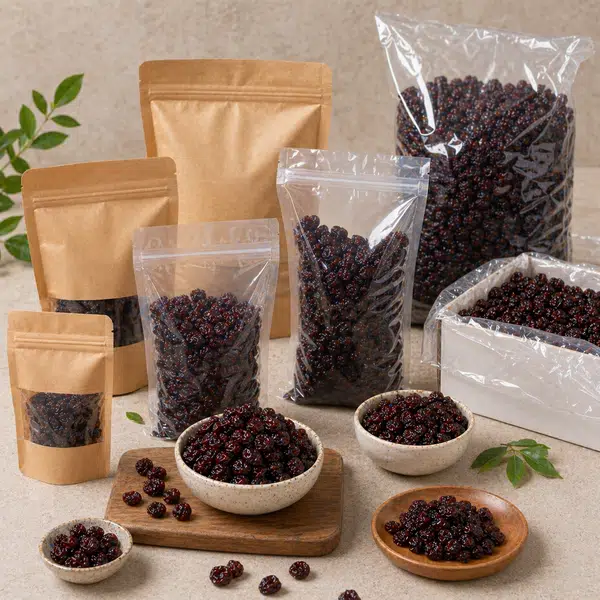
Packaging is not just a finishing decision. For dried sour cherries it directly affects product protection, commercial positioning and shipment efficiency.
Dried sour cherries are sold into several channels with very different operational needs. Retail buyers usually need consumer-friendly pack sizes, strong shelf appeal, label-ready surfaces, reliable sealing and a packaging structure that supports stable product presentation across the declared shelf life. Foodservice buyers, by contrast, often prioritize practical pack weights, handling convenience, easy opening, storage efficiency after opening and cost control per usable kilogram. Because the same fruit can move into both channels, packaging strategy becomes a core commercial decision rather than a secondary detail.
From a technical standpoint, dried sour cherries are sensitive to moisture migration, oxygen exposure, seal performance and mechanical stress during storage and transport. Packaging therefore has to do more than contain the product. It has to help preserve texture, control stickiness, reduce quality drift, support traceability and protect the fruit through export handling, warehousing and onward distribution. If the pack style is mismatched to the product profile or the channel, quality complaints, repacking losses and margin pressure can follow.
Commercially, packaging choices affect material cost, machine compatibility, pallet efficiency, label claims, route-to-market flexibility and the feasibility of private label programs. A buyer who defines unit weight, target sales channel, display preference, pallet expectations and certification needs early will usually receive a more accurate quotation and a more practical offer. This is why foodservice and retail packaging deserves a dedicated article rather than being treated as a small note inside a general product page.
For Atlas, the most useful packaging discussion combines product behavior with market logic. The correct answer is rarely just “small pouch” or “bulk carton.” It is the pack format that protects the fruit, fits the intended user, supports the target market and remains commercially efficient from packing line to final shelf.
These points help buyers evaluate packaging options faster and with fewer revisions.
Retail packaging prioritizes presentation, consumer convenience and label communication, while foodservice packaging focuses on operational efficiency, durability and usable volume.
Material structure should support moisture and oxygen protection appropriate to the fruit profile, storage conditions and planned shelf life.
Unit size, pouch type, carton style, labeling complexity and private label requirements all influence final pricing and lead time.
Even a visually attractive pack can fail commercially if master carton strength, pallet stability, coding or shipment protection are not properly aligned.
Different channels require different packaging priorities, even when the fruit specification is similar.
Usually developed for shelf presentation, convenience and clear branding. These packs often need strong visual layout, controlled fill appearance, reseal potential and market-compliant labeling.
Designed for kitchens, bakeries, cafes, hotels and catering operations where the product is used repeatedly after opening. Practical handling and storage are often more important than shelf impact.
Suitable for importers, distributors and private label operators that perform final packing closer to the destination market. This approach can improve flexibility where multiple SKUs or localized labels are needed.
Some buyers operate across more than one of these channels at the same time. In that case, it may be commercially better to source one qualified fruit profile and then separate the packaging route between bulk export and local repacking, or between retail-ready product and foodservice packs, depending on the economics of labor, logistics and labeling in the destination market.
Retail packaging must protect the fruit while also functioning as a sales and branding tool.
Retail buyers generally define packaging around target price point, consumption occasion and shelf placement. Smaller packs can support trial and impulse purchases, while mid-sized packs may fit repeat household use better.
Stand-up pouches, pillow packs or other consumer-friendly formats may be selected depending on the brand positioning, machine capability and shelf requirements. Window placement, print finish and front-panel clarity can influence perception of quality.
For products intended to be consumed over multiple occasions, resealable features can improve user convenience and help maintain product condition after opening.
Retail packs need space for ingredient statement, nutritional panel, net weight, storage guidance, lot coding, origin information, barcode and any market-specific mandatory declarations.
Retail packaging typically needs stronger focus on seal integrity and barrier performance because the product may remain in ambient distribution and on shelf for longer periods.
Retail programs often require coordinated artwork approval, print lead times, mock-up review, barcode control, carton markings and pallet presentation suitable for retailer intake procedures.
Foodservice users usually care more about handling efficiency, unit economics and consistent operational use than shelf cosmetics.
Pack weight should match the customer’s average consumption rate, storage conditions and risk of repeated exposure after opening. Oversized packs may reduce cost per kilogram but can create usability issues if turnover is slow.
Foodservice buyers often prefer formats that are easy to open, portion and store in back-of-house conditions without causing excessive mess or product loss.
Foodservice packs must tolerate repeated movement between storage and use areas. Bag strength, carton integrity and clear identification become operationally important.
Pack dimensions should fit shelving, bins or kitchen storage systems reasonably well. Compact and stack-efficient formats are often preferred in professional environments.
Even when graphics are simple, buyers still need clear identification for product name, lot number, storage guidance, best-before date and pack weight for inventory control.
Foodservice customers usually evaluate total delivered value, so packaging should be robust and practical without adding unnecessary material cost or decorative complexity.
For foodservice, the best pack is often the one that balances product protection with operational simplicity. Buyers should define whether the pack will be opened and consumed quickly, portioned across multiple shifts or stored after opening. That practical use pattern often determines the right format more clearly than product category alone.
Private label packaging adds another layer of commercial and operational complexity beyond the product itself.
Label and packaging approvals should include dieline review, language control, barcode confirmation, legal text validation and final print approval before production release.
Unit size, channel segmentation and target markets should be aligned early so packaging materials are ordered efficiently and unnecessary SKU complexity is avoided.
Private label projects often need more lead time than bulk programs because material procurement, print scheduling and approval cycles can extend the preparation period.
Retailer or market-specific label rules, claim restrictions and coding standards should be checked before finalizing print materials.
Outer case format should support retail logistics, pallet efficiency, traceability and damage control during international transport and warehouse handling.
Private label programs work more smoothly when expected volume, repeat schedule and material call-offs are shared in advance rather than managed only as ad hoc orders.
Material choice should be linked to product behavior, distribution route and desired shelf-life performance.
Dried sour cherries can be affected by moisture gain or loss depending on the storage environment. Appropriate barrier construction helps maintain texture and reduce quality drift.
Where shelf-life expectations are higher or the product is positioned as premium retail, oxygen exposure control may become more important for preserving sensory quality over time.
Even a good material specification can fail if seals are inconsistent. Seal performance is essential for pack security, shelf-life delivery and complaint prevention.
Pouches, liners and cartons should withstand transport vibration, stacking pressure and warehouse movement without splitting, crushing or causing excessive product compaction.
Packaging should be appropriate for direct food contact and consistent with the applicable regulatory expectations in the destination market.
The chosen material should support the required print finish, barcode readability and lot or date coding method without compromising legibility.
Buyers do not always need to specify the technical structure of the packaging material in detail, but they should clearly state the expected shelf-life, storage environment, sales channel and whether the product is for standard retail, premium retail, foodservice or repacking. These commercial facts help determine the appropriate protection level.
Secondary and tertiary packaging are just as important as the primary pack for successful international shipments.
Master cartons should be selected with consideration for stack height, shipment mode, climate exposure risk and the weight of the packed product.
Case count and orientation should support efficient loading, reduce deformation risk and make downstream warehousing easier for the importer or distributor.
Pallet pattern influences freight cost, warehouse handling and container utilization. It should be aligned with both shipment economics and receiving requirements.
Stretch wrapping, corner support and carton consistency matter because unstable pallets increase the risk of damaged packaging and rejected goods.
Outer cartons should normally carry clear identification for product name, batch or lot reference, net weight, production or best-before coding and other customer-required shipping marks.
Packaging dimensions and pallet style should be considered together to optimize loading efficiency and reduce avoidable transport cost.
Packaging decisions must support the legal and commercial expectations of the target market.
Retail and foodservice labels generally need accurate product naming, ingredient statement, net weight, lot coding, date marking and storage guidance appropriate to the destination market.
These should be aligned with the actual product specification, recipe profile where relevant and the legal expectations of the intended country of sale.
Organic claims, certification marks and any related text should only be used where supported by the product status and required approvals.
Some markets require local language declarations or importer details, which may influence whether final packing is done at origin or destination.
Retail-ready programs usually require barcode accuracy and sometimes additional customer-specific coding or case label conventions.
Recommended storage conditions should reflect how the product is intended to be distributed and used, especially where ambient storage periods may be extended.
The best packaging format is the one that works technically and commercially at the same time.
Premium retail can support higher packaging spend than value channels or industrial foodservice. The pack should match the economics of the final business model.
Higher recurring volumes often justify more specialized packaging materials, dedicated print runs or private label structures that are less practical for small trial orders.
Standard materials and generic bulk formats may be faster to supply than custom-printed retail packs or multi-SKU private label programs.
In some cases, shipping in bulk and repacking near the destination market may offer advantages in flexibility, multilingual labeling or inventory management.
Fast-moving channels may tolerate simpler packaging solutions than slow-moving premium channels where appearance retention and shelf-life assurance matter more.
Distributors, retailers, private label owners and foodservice operators each evaluate packaging differently, so their working model should guide the decision.
Many packaging problems begin with incomplete briefing rather than weak execution.
A good-looking pouch is not automatically the right option if barrier performance, seal strength or transport suitability are not sufficient.
A foodservice customer who reopens packs multiple times may need a very different solution from a retail customer buying for home consumption.
Custom print, approval cycles and packaging material procurement can significantly extend readiness compared with standard bulk shipments.
Quotations are not comparable unless the unit size, material expectation, carton style, label scope and pallet basis are aligned.
A clear briefing helps suppliers prepare realistic offers for foodservice, retail and private label packaging programs.
Confirm the fruit profile, intended channel, quality expectation and whether the pack is for direct sale, foodservice use or later repacking.
State preferred unit size, pouch or bag type, carton count, pallet preference, coding method and whether reseal or display features are required.
Share the destination country, language requirements, certification expectations and whether the product must meet retailer-specific packaging rules.
Clarify whether the requirement is a trial order, regular distribution line, seasonal promotion or ongoing private label program.
If private label is involved, confirm who supplies artwork, who approves it and what lead time is needed for print and final sign-off.
Expected order size and annual demand help determine whether custom packaging is commercially efficient or whether a standard export pack is more practical.
Atlas approaches packaging as part of the total supply program, not as an isolated design choice.
Atlas Global Trading Co. helps buyers structure dried sour cherry supply around channel fit, packaging practicality and export execution. For foodservice and retail packaging discussions, this means aligning the fruit profile with the correct unit format, reviewing the likely storage and handling conditions, clarifying private label or bulk requirements, and building an offer around realistic operational needs rather than assumptions. This reduces unnecessary revisions and helps buyers compare options on a clearer basis.
Whether the requirement is for bulk export, retail-ready packs, foodservice formats or developing a private label line, the main objective remains the same: choose a packaging solution that protects the fruit, supports the target market and works commercially across sourcing, packing, logistics and sale.
Short answers help buyers review the topic quickly before moving into quotation and specification work.
End use, target market, desired quality profile, required certification scope, pack format, unit weight and labeling expectations should be clarified first.
Because foodservice, retail and private label channels have different operational, shelf-life, presentation, labeling and commercial requirements.
In many cases yes, provided the fruit profile, packaging materials, certification status and documentation set are aligned with the customer requirement and the target market.
Moisture protection, oxygen barrier, seal integrity, pack durability, labeling compliance, pallet efficiency and the fit between packaging format and intended sales channel matter most.
No. For some importers and multi-market distributors, bulk supply followed by local repacking may offer better flexibility, faster label adaptation and more efficient inventory management.
Because unit size, print complexity, material structure, carton style, pallet arrangement and documentation requirements can materially change the total offer.