Crop-year dependence
Dried sour cherries begin with seasonal raw fruit, so annual availability and harvest quality can influence the entire pricing structure for the crop year.
A practical trade and sourcing guide for buyers evaluating what really shapes dried sour cherry pricing and where the main commercial risks usually appear in export, repacking, industrial and private label supply.
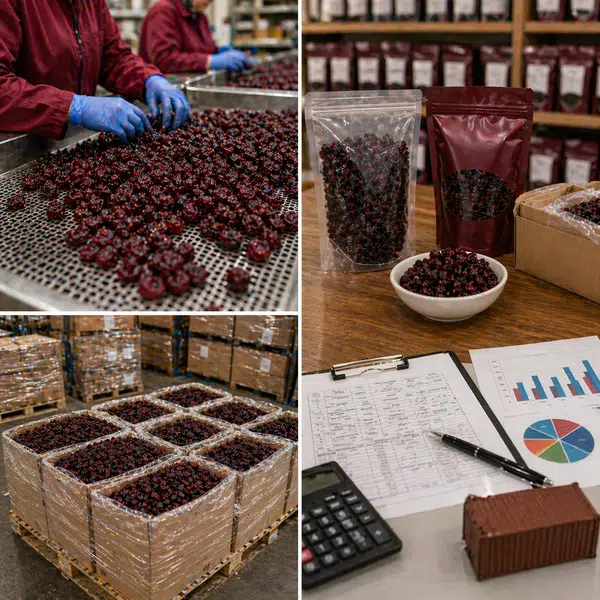
Dried sour cherry pricing often looks simple from a distance, but the real commercial picture is shaped by several interacting factors.
Dried sour cherries can serve multiple channels, from premium retail to bakery, cereal, snack, foodservice and industrial ingredient use. Their acidity, color and flavor intensity can create strong market value, yet buyers often approach the category with overly simplified price expectations. Asking only for a price per kilogram rarely produces a meaningful comparison because the product's value is influenced by crop conditions, processing yield, sweetness balance where relevant, visual quality, format, packaging, certification, timing and channel requirements.
That is why buyers usually need a more structured conversation before benchmarking offers. The right commercial question is not only what the price is today, but what exactly is being quoted, under what crop-year conditions, for which end use and with which operational commitments. A bakery user may prioritize cuttability, moisture control and continuity, while a retail buyer may value consumer presentation, compliance, branding and pack consistency. These are different commercial realities and they often produce different price structures.
In practice, successful dried sour cherry programs are built around timing and specification discipline. Crop windows, raw fruit cost, drying yield, packaging materials, freight conditions, compliance scope and target channel all affect final competitiveness. A supplier conversation becomes much clearer when buyers share estimated annual demand, program type, quality expectation, pack format and whether the requirement is conventional or organic.
Atlas treats price and risk as part of one sourcing discussion. The goal is not only to quote the fruit, but to help the buyer understand which cost drivers are structural, which are program-specific and which risks can be reduced through better planning.
Price variation is usually linked to the structure of the offer, not only to market volatility.
Dried sour cherries begin with seasonal raw fruit, so annual availability and harvest quality can influence the entire pricing structure for the crop year.
Drying fruit into a stable export product depends on usable raw material and process yield. When yield is tighter, the finished product cost can move meaningfully.
Two dried sour cherry offers may look similar by name but differ in quality tolerance, cut, appearance, moisture style, sweetness profile, packing and certification. Those differences affect price directly.
Retail, private label and industrial programs place different demands on packaging, documentation, consistency and risk. That commercial complexity is reflected in the final offer.
These are the factors that usually explain why one quotation differs from another.
Fresh sour cherry availability, usable volume and crop-year quality shape the starting cost logic for the dried product.
The relationship between raw fruit intake and finished dried output is commercially important. Lower yield or more selective raw material usually pushes cost upward.
Appearance, size consistency, moisture style, sweetness balance, piece integrity and acceptable defect level all affect commercial value.
Whole fruit, cut formats, industrial use profiles or retail-ready presentation can each create different cost structures depending on the process and packing logic involved.
Bulk export, foodservice, retail and private label programs do not carry the same packaging cost, labor intensity or approval burden.
Organic and other compliance-sensitive programs can carry different sourcing, segregation, documentation and approval costs than conventional supply.
Program size can affect commercial efficiency, especially where packaging materials, shipment planning or annual volume commitments are involved.
Early seasonal planning may create more room for structured offers than late-stage purchasing after stock positions, packaging or capacity are already committed.
Container timing, destination, pallet structure and logistical complexity influence landed competitiveness even when the product spec is unchanged.
Buyers often believe they are comparing like for like when they are actually comparing different commercial products.
A major pricing mistake in dried sour cherries is assuming the category name alone is enough to compare offers. In reality, the commercial value changes with product definition. One buyer may need cleaner-looking fruit for retail, another may need ingredient-grade fruit with different tolerance levels, and another may need a format suited to processing rather than direct sale. If these expectations are not made explicit, prices become difficult to interpret correctly.
Moisture style, visual consistency, sweetness profile, cut or whole format, packing method and acceptable process loss can all change the cost picture. Even when the fruit itself comes from the same season, the commercial offer may differ substantially because one program requires more sorting, more careful packing, tighter quality control or broader documentation. A useful quotation therefore depends on a useful brief.
For this reason, buyers should define product format, intended use, quality tolerance and packaging structure before using price as the main benchmark. Good commercial discipline reduces confusion and leads to more relevant sourcing decisions.
The same dried sour cherries may create different levels of risk depending on where and how they are sold.
These often focus on function, continuity, manageable moisture, cutting behavior, flavor consistency and process suitability. The risk is usually operational performance rather than shelf appearance.
Retail buyers usually face more exposure to visual complaints, label issues, pack consistency expectations and timing pressure linked to shelf launches and promotions.
Private label adds approval risk, artwork risk, timing risk and brand-exposure risk because the product reaches the consumer in the final finished pack.
Bulk supply can reduce some export-side complexity, but it shifts more responsibility to the importer for local packing, labeling, inventory control and downstream consistency.
Most sourcing problems are not caused by one big failure. They are usually the result of several unmanaged smaller risks.
If buyers wait too long to plan, they may face tighter stock positions, less pack flexibility or weaker alignment with their preferred product profile.
An unclear brief can lead to a product that is commercially correct for one channel but unsuitable for the actual intended use.
Bulk, retail and private label formats carry different packaging timelines, material dependencies and cost sensitivities. These should be defined early.
Customer-specific templates, certifications, specifications and label approvals can delay dispatch if they are not built into the project plan from the start.
Container scheduling, pallet format, warehouse readiness and route timing can influence landed cost and arrival performance even after the fruit is produced correctly.
Unrealistic or very late demand signals make it harder to plan seasonal stock, packaging materials and shipment sequences efficiently.
Both can be viable programs, but they should not be benchmarked without considering structural differences.
Conventional programs may offer greater flexibility in some commercial situations, but price still depends heavily on crop-year volume, format, packing and channel complexity.
Organic programs often involve more specific raw material allocation, segregation discipline, documentation control and label sensitivity, which can affect pricing and planning requirements.
Where organic private label or retail supply is involved, label review, certificate alignment and transaction-level documentation may add more commercial work than a simpler conventional bulk shipment.
Buyers needing specialized organic supply often benefit from earlier forecasting and clearer program commitment than buyers operating in more flexible conventional channels.
Not every buyer needs a contract program, but repeated spot buying can create its own hidden commercial costs.
Spot buying can be useful for trials, opportunistic purchasing or secondary line extensions, but it often provides less continuity and less planning power than a structured annual program. Buyers relying only on spot supply may need to accept wider variation in timing, pack availability, stock allocation and operational predictability. That does not always make spot purchasing wrong, but it does mean the risk profile is different.
Annual or recurring programs generally improve planning across volume allocation, pack material ordering, documentation flow and shipment scheduling. They can also reduce the internal cost of repeated negotiation, repeated onboarding and repeated approval cycles. For buyers serving retailers, industrial contracts or private label programs, that continuity is often commercially more valuable than trying to optimize every shipment independently.
The right choice depends on the buyer's business model. What matters is that the quotation basis matches the actual procurement strategy. Comparing a structured annual offer to an opportunistic one-off spot price rarely gives a fair picture of total commercial value.
The more complete the brief, the more useful the price comparison becomes.
Clarify whether the dried sour cherries are for retail, private label, bakery, cereal, foodservice, repacking or industrial ingredient use.
Define whether the requirement is whole, processed, retail-oriented, ingredient-oriented or another specific format relevant to the application.
State the visible quality standard, moisture style, acceptable tolerance level and whether pack appearance matters commercially.
Bulk, foodservice, retail and private label structures create different cost and risk profiles and should not be treated as interchangeable.
Conventional and organic programs should be separated clearly, especially where label claims or customer approval depend on them.
Indicate whether the inquiry is a trial, spot order, recurring annual program or launch-based project with retailer or brand deadlines.
A short checklist helps buyers and sellers move faster toward a realistic quotation and a lower-risk supply structure.
Confirm the dried sour cherry format, quality expectations, sweetness profile if relevant and whether the product is for direct sale or further processing.
State whether the requirement is for a trial, recurring order, annual contract, bulk repacking program or private label launch.
Share carton, bag, pouch, pallet and labeling expectations early because these details influence both cost and execution risk.
Clarify shipment timing, launch windows, promotion dates or replenishment rhythm so the quote reflects the true operating need.
Define whether the program is conventional or organic and whether customer-specific certificates, declarations or label approvals are required.
Provide at least an approximate annual or seasonal requirement so the supplier can distinguish between opportunistic spot business and structured supply planning.
These points make the article immediately useful for importers, processors, distributors and brand teams.
Dried sour cherry prices depend on crop-year conditions, specification, pack format, certification, timing and channel complexity, not only on the fruit name.
Buyers get more meaningful offers when end use, quality level, packing and program type are defined before comparing prices.
Late forecasting, vague briefs and incomplete planning often create more avoidable risk than market volatility itself.
Industrial, bulk, retail and private label programs carry different risk profiles, approval demands and cost structures.
Organic pricing and risk should be evaluated with certification, segregation, label and documentation requirements in mind rather than treated as a simple premium add-on.
Well-structured recurring supply often improves continuity, planning efficiency and approval flow compared with repeated reactive spot buying.
Short answers help buyers review the topic quickly and keep the page practical for trade use.
Buyers should first clarify end use, target market, product format, expected quality level, required certification profile, preferred pack format and whether the program is spot-based or annual.
Because dried sour cherry pricing is influenced by more than the fruit itself. Crop conditions, format, yield, processing cost, pack choice, compliance, shipping logic and customer risk profile all affect the final commercial offer.
The main price drivers are crop-year availability, raw fruit quality, drying yield, product specification, packing format, certification scope, order volume, timing of booking and the complexity of the final customer program.
No. A lower quote may reflect a different product definition, simpler packaging, weaker compliance scope or a commercial model that does not match the buyer's actual operating needs.
Because they usually include added packaging work, label control, approval steps, documentation depth and timing sensitivity beyond the fruit itself.
In many cases yes, provided the fruit, certification scope, packaging structure and documentation flow are aligned with the buyer requirement and available sourcing program.