Breakfast cereals & muesli
Used as soft fruit inclusions in muesli and cereal mixes where manufacturers want visible fruit pieces, dark color contrast and mild natural sweetness without relying entirely on sugar-coated inclusions.
Prunes are a versatile dried fruit ingredient for cereal manufacturers, granola producers, snack mix blenders and functional food developers that need natural sweetness, soft chew, fruit identity and stable commercial supply in bulk formats.
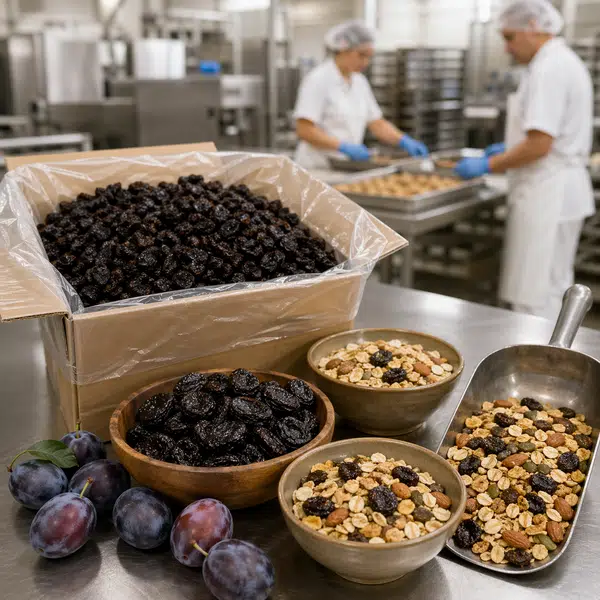
This category is not just about fruit inclusion. It is about process compatibility, texture control, commercial consistency and final pack performance.
Prunes, also traded as dried plums, offer a distinctive position in industrial breakfast and snack applications because they combine natural fruit sweetness, dark color, soft bite and a more indulgent profile than many standard raisin-type inclusions. In breakfast products such as muesli, granola, porridge toppers and cereal blends, prunes contribute chewiness, visual contrast and recognizable fruit character. In snack mixes, they can support premium fruit-and-nut concepts, better-for-you positioning and soft-texture balance against crunchy inclusions like seeds, almonds, cereals or baked clusters.
From an industrial point of view, prune sourcing is not only a matter of buying a dried fruit. The required specification is shaped by the processing line. Some customers need clean whole pitted fruit for repacking or manual blending. Others need diced or chopped fruit sized for automated blending systems, portion control and even distribution in dry mixes. The practical concern is how the fruit behaves in storage, dosing, blending, transport, retail shelf life and consumer use.
Compared with many other dried fruits, prunes can deliver a richer flavor impression and softer texture, but that benefit must be managed carefully. If the fruit is too moist or tacky, it may bridge in hoppers, clump in bags, smear during cutting or transfer stickiness to adjacent ingredients. If it is too dry, it may lose the soft-eating advantage expected in breakfast and snacking formats. For that reason, technical fit and commercial fit must be discussed together.
For importers, food manufacturers and private label buyers, the most successful prune programs begin with a clear brief: intended application, cut format, expected softness, acceptable appearance, microbiological profile, certification requirement, packing style and annual volume pattern. Once these points are aligned early, price benchmarking becomes more realistic and supply proposals become more comparable.
Industrial demand is usually divided by formulation style, texture objective and how visible the fruit should be in the finished pack.
Used as soft fruit inclusions in muesli and cereal mixes where manufacturers want visible fruit pieces, dark color contrast and mild natural sweetness without relying entirely on sugar-coated inclusions.
Suitable for premium granola concepts where prune pieces add chewiness alongside oats, nuts and seeds, especially in fruit-forward or digestive-wellness product positioning.
Included in nut-fruit blends and soft snack packs where prune texture can complement crunchy ingredients and support a premium dried fruit assortment.
Selected for formulations that focus on fiber-rich fruit content, natural ingredient storytelling or reduced refined sugar positioning in everyday snacking.
In some concepts, smaller prune cuts are used where manufacturers want a softer fruit experience and recognizable fruit ingredients in family-oriented breakfast blends.
Packed either as single-fruit components or as part of multi-fruit assortments for retailers seeking differentiated dried fruit and breakfast topping lines.
The right format depends on dosing equipment, blend ratio, pack style and the consumer eating experience the manufacturer wants to achieve.
Preferred when fruit visibility is important, when the buyer repacks or further processes the fruit, or when larger intact pieces support a premium appearance. Whole fruit can work in higher-value snack mixes but requires close control of moisture and stickiness for efficient blending.
Often the most practical industrial format for breakfast mixes because cut size helps distribution throughout the blend, improves portioning consistency and makes consumer use easier. Diced fruit is especially relevant when every spoonful or handful should contain balanced fruit inclusion.
Useful when processors want a more natural irregular cut rather than uniform cubes. This can suit artisanal-looking granola and muesli concepts, although size consistency still matters for bulk handling and pack presentation.
For industrial buyers with defined line settings, custom cut ranges may be discussed based on required dimensions, dust tolerance, bulk density and target fruit inclusion percentage in the final recipe.
Price alone does not determine suitability. The practical performance of the fruit in the production line is usually the bigger issue.
Prunes for dry mix systems need a workable balance between softness and handling stability. Excessive surface tack can create clumping, while insufficient softness may reduce eating quality and fruit identity. Buyers should define whether the line prioritizes free flow, soft chew or a balance of both.
For diced or chopped material, the proportion of fines, paste-like particles and broken fragments affects blend appearance, fruit distribution and pack cleanliness. A good industrial specification normally defines the acceptable range of small particles and oversized pieces.
Because prunes are naturally dark, buyers often accept some natural variation, but consistency still matters in retail-facing mixes and private label programs. Uneven appearance may affect visual quality perception, particularly in transparent or partially transparent packs.
The desired prune flavor may vary by market. Some blends require mild sweetness that does not dominate cereals and nuts, while others want a fuller fruit taste that helps create a richer premium profile.
Industrial programs often require pre-agreed microbiological parameters aligned with the target market and application. This is especially important when the fruit is used in ready-to-eat blends with no further kill step after mixing.
As with all industrial dried fruit ingredients, the processing program should support foreign matter control through cleaning, sorting and inspection measures appropriate to the specification and customer standard.
Moisture is not just a technical detail. It directly affects waste, line efficiency, shelf stability and complaint risk.
In breakfast and snack mix manufacturing, moisture management is one of the most important discussion points for prune inclusions. If the fruit presents too much free surface stickiness, it can agglomerate during warehousing or after packing, especially in warm logistics conditions. It may also reduce blend homogeneity because fruit pieces can attract fines or adhere to cereal clusters.
On the other hand, if the prune specification is pushed too far toward dryness for easier flowability, the finished product may lose the soft and satisfying chew that makes prunes commercially attractive in the first place. This is why experienced buyers tend to define acceptable handling behavior rather than asking for a generic dry or moist fruit profile.
For manufacturers, the cost effect is significant. A fruit that is nominally cheaper per kilogram can still be more expensive in use if it causes higher line stoppage, lower dosing accuracy, more cleaning time, dustier blends, inconsistent pack distribution or more customer complaints about clumps and texture. A realistic industrial quotation therefore needs to account for performance, not only invoice price.
Buyers in this segment usually compare not just fruit quality but also supply reliability, pack efficiency and program flexibility.
Annual or seasonal demand estimates help suppliers plan raw material allocation, processing windows and packaging procurement more efficiently than spot-only inquiries.
Bulk industrial users commonly evaluate inner liner quality, carton strength, stackability and pallet efficiency because these details influence warehouse handling and inbound cost.
Destination country matters because labeling, documentation, certification expectations and importer controls may differ across regions and customer channels.
Sample and trial quantities help validate technical fit, but recurring programs generally create better continuity, more predictable processing schedules and stronger pricing discipline.
The most common cause of quotation mismatch is an incomplete specification. End use, cut size, moisture preference, tolerance expectations and certification profile should be defined before benchmarking offers.
Serious buyers normally review crop timing, carryover risk, container booking conditions, lead times and documentation readiness before approving a new prune supply line.
These are the points that tend to shape a practical industrial discussion.
Manufacturers want prune pieces that are easy to distribute in cereal and snack blends without settling excessively at the bottom of the pack or clustering together during transport.
Fruit pieces should remain workable in production and storage, especially where blends are packed in flexible bags, stand-up pouches or composite breakfast packaging.
Industrial users often want predictable sweetness, aroma and chewiness so that the final product remains consistent across multiple batches and production dates.
When the finished blend is sold through modern retail, prune appearance still matters even in an industrial application, particularly for premium granola and transparent snack packs.
Industrial buyers usually ask for a reliable technical document package to support approval, onboarding and recurring procurement workflows.
Brand owners and contract manufacturers prefer stable multi-shipment programs over ad hoc availability because reformulation and source changes can be costly.
Packing should be matched to the product format, logistics route and receiving conditions of the customer.
Common for food manufacturing and import distribution, especially where buyers receive the fruit into ingredient warehouses and feed it into secondary handling or blending operations.
Applicable when regional distributors, repackers or specialty channels require smaller wholesale pack sizes rather than full industrial bulk handling.
In some cases, prune-based breakfast and snack assortments may transition from bulk ingredient sourcing into branded or retailer-specific finished pack programs.
From a trade perspective, the correct packaging format helps protect fruit integrity, manage moisture migration, maintain hygiene during transport and reduce unnecessary handling damage. Buyers should also clarify palletization pattern, labeling language, barcode expectations and any destination-specific mark requirements at quotation stage rather than after order confirmation.
Industrial procurement teams often need more than a product brochure. They need a specification framework that fits internal approval systems.
A clear spec should describe the product format, pitted status, cut style if relevant, tolerance logic, packing format and any critical physical or sensory expectations.
Programs may require conventional supply, organic supply or specific customer-aligned certification documentation depending on market channel and brand positioning.
Traceability matters in modern food supply chains because lot identification, shipment records and production references support recall discipline and customer confidence.
Import requirements differ by country and channel, so documentation and compliance planning should be aligned with the final destination from the start.
Prunes are usually chosen when a manufacturer wants more than a low-cost fruit inclusion.
Prunes can help round out the sweetness profile of fruit-and-cereal mixes and may support cleaner ingredient positioning compared with more heavily processed sweet inclusions.
They provide a soft, dense fruit bite that can contrast well with crisp cereal pieces, toasted oats, nuts and seeds.
In the right formulation, prunes can support a richer and more mature taste profile than standard sweet dried fruit inclusions, especially in premium breakfast and adult snack concepts.
The same base ingredient can support industrial blends, wholesale packing and selected retail fruit mix concepts when the specification is built correctly.
Knowing the risk points early helps reduce costly reformulation or sourcing changes later.
Prunes may require careful format and moisture selection if the production line is designed primarily for free-flowing dry ingredients.
If cut size is not matched to the rest of the formula, fruit pieces may distribute unevenly or affect visual consistency across packs.
Long transit routes and warm storage conditions can influence handling behavior, especially in soft fruit formats with higher tack tendency.
Many sourcing issues come from vague inquiries rather than true supply limitations. A well-defined product brief avoids this problem.
Buying on headline price without evaluating in-use performance can increase real production cost through wastage, downtime or consumer complaints.
Before committing to scale, line trials should confirm blend behavior, dosing, pack appearance and finished product stability.
A structured inquiry helps suppliers prepare a faster and more relevant quotation.
State whether you need whole, diced or chopped prunes, whether the fruit will be sold as-is or blended further, and whether visual appearance or process efficiency is the main priority.
Clarify expected texture, preferred handling behavior, target cut size, tolerance philosophy and any microbiological or compliance requirements relevant to your market.
Share forecast volume, shipment rhythm, destination, certification requirement, packing format and whether the request is for a trial, seasonal program or long-term recurring supply.
These points usually define whether a prune program becomes efficient and repeatable.
Prunes for breakfast cereals and snack mixes should be selected according to the production system and final eating experience, not just the raw fruit description.
Whole, diced and chopped prunes can behave very differently in blending, packing and retail presentation, so the format should be fixed before price comparison.
The right moisture and texture balance can improve line efficiency, reduce clumping and support finished product consistency.
Buyers who provide forecast visibility generally gain a more stable sourcing structure than those relying only on short-term spot purchases.
Short answers to common industrial buying questions.
The preferred format depends on the recipe and equipment, but diced and chopped prunes are often selected for easier distribution, more consistent dosing and better fruit inclusion control in cereal and snack blends.
Moisture affects stickiness, flowability, clumping tendency, texture retention, cleaning frequency, shelf stability and overall line efficiency. It is one of the most important practical selection criteria.
End use, cut size, desired texture, certification profile, microbiological expectations, pack format, target market, annual volume and shipment rhythm should be clarified before quotations are compared.
In many cases yes. The final offer depends on the requested certification scope, product profile, packing requirement and available processing program aligned with the customer market.
Atlas supports international buyers that need industrial dried fruit sourcing with practical commercial communication and specification-oriented supply discussions.
If your company is developing a breakfast cereal line, fruit-and-nut snack range, granola series or private label blend that requires prunes, the most efficient starting point is a clear product brief. Atlas can structure the conversation around application, cut format, target quality level, compliance profile, packing and shipment logic so the sourcing discussion is aligned with your real production and commercial needs from the beginning.