Pack format and carton strength
The type of primary and secondary packaging strongly influences how the goods should be loaded, stacked and supported during export transit.
A practical technical and commercial guide explaining how buyers manage container loading, shipment transit and warehouse storage for sultana raisins so the product arrives in stable, saleable condition and remains commercially usable after receipt.
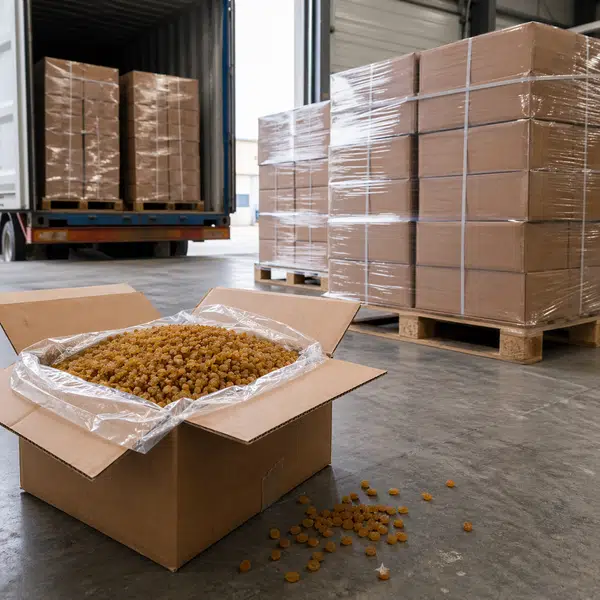
Good fruit and correct packing still depend on correct loading, transit protection and storage discipline to preserve commercial value.
Sultana raisins are a stable dried fruit product when handled correctly, but stable does not mean risk-free. The commercial result of an export shipment depends not only on grade, pack format and documentation, but also on how the goods are loaded into the container, how they travel, and how they are stored after arrival. A well-packed shipment can still lose value if cartons are stressed during loading, if pallets shift during transit, if moisture exposure is not controlled, or if the receiving warehouse stores the product in unsuitable conditions.
For importers, distributors, foodservice buyers and private label programs, loading and storage decisions matter because they affect more than physical protection. They influence claim risk, arrival presentation, warehouse handling efficiency, stock rotation, re-packing performance and the customer's confidence in repeat shipments. In long-distance export trade, these operational details are often what separate a smooth program from a problematic one.
When discussing container loading, transit and storage for sultana raisins, the first question is not only what fruit is being shipped, but how the product is packed, how far it is travelling, in what season it is moving, and how the buyer intends to receive and hold stock. A distributor that will rotate inventory quickly may manage stock differently from a retailer holding packaged product across multiple warehouses. A bulk industrial buyer may prioritize strong pallet performance, while a private label buyer may focus more heavily on protecting retail-ready case presentation.
Atlas prepares logistics-focused articles like this because technical-commercial success in dried fruit trade depends on the full chain, not just the purchase order. Clear loading methods, sensible transit planning and disciplined storage conditions reduce damage risk, preserve pack integrity and support stronger long-term supply performance.
Many logistics problems can be reduced early if the shipping and receiving conditions are discussed before cargo is packed.
The type of primary and secondary packaging strongly influences how the goods should be loaded, stacked and supported during export transit.
Longer routes, transshipment patterns and warm-weather periods may increase the importance of careful container condition checks and disciplined loading practice.
Importers should know in advance whether the goods will move into a cool, dry and well-managed warehouse or into a more challenging storage environment with longer dwell time.
Whether the buyer plans pallet-in, case-pick, cross-docking, wholesale redistribution or direct retail dispatch affects the most practical shipment configuration.
Loading should protect both the product and the packaging, while keeping the shipment efficient and stable throughout the journey.
Container loading for dried fruits is not just about fitting the maximum quantity into the available space. It is a balance between load efficiency, pallet stability, carton protection and handling safety. Sultana raisins may be commercially robust, but their packaging can still be damaged by compression stress, uneven stacking, weak pallet build or rough movement during the voyage. Good loading practice aims to keep the cargo stable from the warehouse door to the consignee's receiving area.
Before loading, the container itself should be clean, dry, odor-free and fit for food cargo. The floor condition, door seals and general cleanliness matter because cargo can be affected by contamination, residual smells or excess moisture from previous use. The loading team should also check that the container is suitable for the pack type and pallet layout planned for the shipment.
During loading, the objective is to create a stable and uniform cargo arrangement. Weight distribution should be sensible, pallet positions should support balance, and cartons should not be forced into configurations that distort cases or damage retail-ready presentation. Where palletized loading is used, pallet integrity and stretch-wrap discipline are important. Where floor loading is used, case arrangement must still preserve structure and minimize movement risk.
Cleanliness, dryness, odor control and structural suitability should be checked before cargo enters the unit.
Pallet arrangement and case positioning should minimize shifting, leaning and compression damage during transit.
Loading should preserve both product condition and pack presentation, especially for retail or private label shipments where outer case quality matters.
Pallet design is one of the most important practical controls in dried fruit export logistics.
Palletization affects transport efficiency, warehouse handling, unload speed and damage risk. A strong pallet build can improve container performance significantly, while a weak one can create claims, rework and additional receiving costs. For sultana raisins, pallet design should consider carton board strength, case dimensions, total stack height, the stability of the chosen pattern and how the pallets will be handled after arrival.
Good palletization generally aims for even load distribution, straight case alignment, sufficient wrap stability and practical height management. Excessively tall or unstable pallets may reduce container security and create receiving issues at destination. Pallet choice should also reflect the buyer's warehouse system and whether the goods are going to a distributor, industrial site, wholesale storage or retail-oriented supply chain.
A well-built pallet reduces the risk of damaged cartons, unstable unloading, re-stacking costs and presentation loss on arrival. This is especially important for packed consumer or private label product where case appearance can influence downstream acceptance.
The voyage period is where loading decisions and pack quality are tested under real conditions.
Transit exposes the shipment to movement, temperature fluctuations, handling events and delays that cannot always be controlled after dispatch. This is why export planning for sultana raisins should consider not only the shipping booking but the physical behavior of the cargo over the full route. Even when the fruit itself is stable, the packaging must still survive multiple loading points, container movements and varying ambient conditions.
Importers and suppliers generally benefit from planning with realistic transit assumptions rather than ideal scenarios. If the cargo route includes transshipment, longer dwell times or warm seasonal periods, the loading and packing discipline becomes even more important. The objective is to ensure the goods arrive in commercially acceptable condition without unnecessary carton damage, moisture exposure or stock-handling complications.
Container motion during sea and inland transport can stress pallets and cases if the load is not well stabilized.
Longer transit or port dwell periods increase the importance of robust packaging and sensible cargo protection.
Every transfer point introduces a chance of impact or distortion, especially if the outer case format is weak for the load pattern used.
Environmental control is one of the key practical topics in dried fruit logistics.
Sultana raisins should be protected from avoidable moisture exposure, excessive heat and odor contamination throughout loading, transit and storage. While dried fruits are lower-risk than highly perishable fresh produce, they still benefit from disciplined logistics conditions. Moisture can affect packaging integrity and product handling character. Excessive heat can put unnecessary stress on packaging and storage stability. Strong odors in the container or warehouse can also create avoidable commercial risk because food products should not be exposed to unsuitable surrounding materials.
That is why containers should be checked before loading, warehouse environments should be managed properly, and cargo should not be stored next to materials that may transfer smell or create poor handling conditions. Practical discipline in these areas helps preserve both physical and commercial quality.
Environmental failures can reduce product confidence, create receiving disputes and increase the chance that the buyer must inspect, rework or isolate stock that should have moved directly into sale or use.
Receiving warehouse conditions are part of the supply chain, not a separate issue outside the buying decision.
After arrival, sultana raisins should be stored in clean, dry, orderly warehouse conditions and protected from direct sunlight, excessive heat, rough handling and prolonged exposure to unsuitable environments during unloading. Good stock management begins from the first receiving step. If pallets are left uncovered in poor conditions or if cases are damaged during unloading and not isolated promptly, the buyer may lose part of the commercial value created earlier in the chain.
Storage practice should also match the pack format. Bulk industrial cartons may tolerate warehouse handling differently from retail-ready cases that must preserve presentation for resale. Private label and retail shipments usually benefit from more careful case handling because the outer packaging is part of the product offer. In all channels, warehouse discipline supports cleaner stock rotation, faster order picking and more consistent customer experience.
Storage areas should be free from excess dampness, contamination sources and unnecessary exposure to adverse conditions.
Goods should be protected from excessive heat and from poorly controlled storage zones that may stress packaging and stock condition.
Forklift use, pallet movement and case-picking methods should preserve pack integrity rather than create avoidable compression or tearing.
Transit success can still be undermined if warehouse rotation and batch management are weak after arrival.
Inventory control matters because dried fruit programs often run across multiple shipments, production periods and customer releases. Importers and distributors should manage lot traceability, receipt timing and stock rotation carefully so older stock is not trapped behind newer arrivals without commercial reason. This is especially relevant in annual or recurring programs where several shipments may overlap in the warehouse across different sales cycles.
Clear lot identification, sensible first-in-first-out discipline where appropriate, and organized pallet mapping help buyers maintain quality confidence and reduce confusion in dispatch. These practices also support better complaint handling and faster internal quality checks when needed.
Strong inventory discipline reduces mis-picks, supports customer confidence, makes audits easier and protects repeat supply programs from avoidable internal handling failures.
The same shipment may require different handling priorities depending on the buyer model.
Usually prioritize pallet practicality, efficient unloading and functional stock management for production use rather than premium outer-case presentation.
Need practical, damage-resistant cases that can move efficiently through multi-customer warehouse environments.
Often care more about preserving case quality and presentation because damaged outer packaging can affect downstream acceptance and shelf readiness.
Usually require both strong physical protection and high presentation discipline because the pack itself carries the buyer's brand promise.
Often want a balanced model where storage practicality, re-sale handling and commercial durability all matter.
May place additional emphasis on segregation, traceability and stock control to maintain certification integrity throughout storage and dispatch.
Many shipment problems come from operational shortcuts rather than from the fruit itself.
Loading into a container that is damp, dirty or odor-affected can create avoidable commercial risk from the start.
Unstable stacking or insufficient wrap can lead to movement, carton distortion and arrival damage.
Excessive stacking pressure can damage lower cartons and reduce the saleable presentation of the shipment.
Rough receiving can create just as much damage as poor loading, especially with retail-ready or presentation-sensitive packed goods.
Improper storage after arrival can undermine the work done during production and export preparation.
Without good pallet and lot control, buyers may struggle to manage stock rotation, complaints or certification-sensitive programs.
A strong logistics brief makes container execution more predictable and reduces misunderstandings between shipper and consignee.
Experienced buyers usually define logistics expectations with the same clarity they apply to fruit grade or packaging. A useful instruction set often includes pack type, pallet configuration, maximum height preference, outer case sensitivity, label visibility, shipment route sensitivity, receiving warehouse conditions and whether the cargo is intended for immediate use, storage or redistribution. When these details are shared early, loading can be optimized for the real destination need rather than for a generic shipping assumption.
This is especially important in recurring or annual programs. Repeated shipments benefit from a standard loading and storage logic because it improves consistency, reduces claim risk and makes warehouse handling more predictable at both ends of the chain. Over time, that consistency becomes a commercial advantage.
These points make the article immediately useful for importers, warehouse teams and brand owners.
Container loading should support stability, clean handling and protection of both the fruit and the packaging.
Shipment duration, transshipment exposure and seasonal conditions should all be considered when building the export plan.
Clean, dry and well-managed storage preserves stock condition and reduces avoidable handling losses.
Weak pallet builds can create damage, extra labor and disputes that affect total landed performance.
Outer case condition can influence downstream acceptance and resale readiness, not only transport practicality.
Organized lot control and sensible stock rotation help importers manage repeat supply more confidently.
A short checklist helps buyers and sellers move faster toward a practical shipment and storage plan.
Confirm format, grade, pack sensitivity and whether the shipment is intended for industrial use, foodservice distribution, retail sale or private label stockholding.
Share pallet preference, maximum height expectations, case sensitivity, labeling visibility and whether palletized or floor-loaded shipment is preferred.
Clarify route sensitivity, seasonal concerns, expected shipment timing and any requirement for stronger load protection.
State how the goods will be stored on arrival, for how long, and whether the warehouse environment has any handling limitations that affect the shipment plan.
Share receiving equipment, pallet type compatibility, stock rotation method and any need for clear lot visibility during put-away and dispatch.
State whether the inquiry is for a one-off trial, repeated shipment flow or annual program so the logistics model can be aligned with continuity needs.
Short answers on logistics help buyers review the topic quickly.
Buyers should first clarify end use, target market, desired grade, packing format, shipment method, storage conditions after arrival and any destination-specific handling expectations.
Because shipment execution and storage discipline can affect product presentation, packing integrity, arrival condition, commercial risk and supply continuity just as much as the fruit specification itself.
Yes. The same logistics and storage principles usually apply to both organic and conventional programs, although segregation, traceability and handling discipline may be especially important in certified supply chains.
Because container loading affects pallet stability, carton protection, ventilation conditions, handling risk, space efficiency and the likelihood of the cargo arriving in the same commercial condition in which it was packed.
Clean, dry, cool and well-managed warehouse conditions matter most, along with protection from direct heat, moisture exposure, odor transfer, rough handling and unnecessary delays in unloading or stock rotation.