Price follows specification
Sultana pricing changes when grade, cleaning standard, certification profile, packaging model, shipment basis or documentation scope changes.
A practical buyer guide covering sultana raisin price formation and commercial risk factors, with focus on grade economics, crop variables, processing intensity, certification, packaging, logistics and total program value.
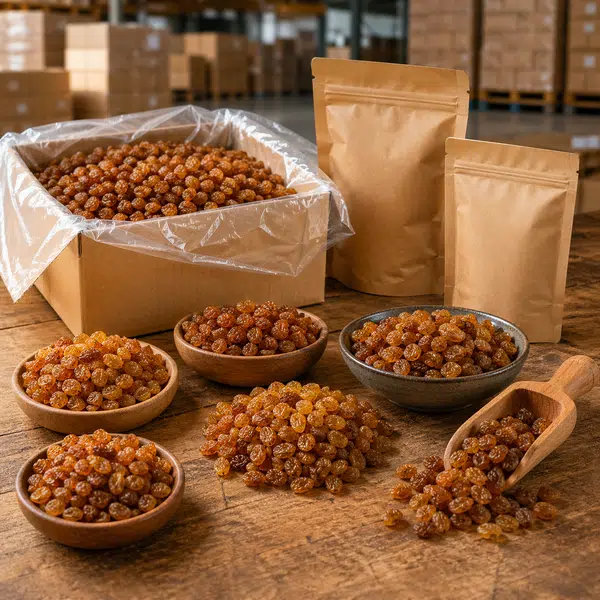
Sultana raisins are one of the most established dried fruit categories in global trade, but pricing still depends on far more than volume alone.
Turkish sultanas are used across retail, baking, cereals, confectionery, snacking, foodservice and industrial ingredient applications. Because the category is broad and commercially familiar, buyers sometimes assume pricing is simple and highly standardized. In practice, however, sultana raisin price formation depends on several interacting variables: crop outcome, grade definition, cleaning and processing intensity, appearance expectations, certification profile, packaging route, logistics structure and the buyer's required level of commercial support.
This means that two quotations for “sultana raisins” may not be directly comparable, even when both appear to come from the same origin and category. One offer may reflect a tighter cleaning standard, a more selected grade, a consumer-facing pack format, a more formal documentation burden or a different shipment basis. Another may be built around a practical bulk export program for further processing. Unless these differences are aligned, headline price comparison can lead to misleading sourcing decisions.
Commercial risk factors matter just as much as product cost. A lower quote can become more expensive if it increases the probability of complaints, repacking losses, delayed shipment, documentation mismatch, weak pallet performance or insufficient grade consistency for the buyer's real application. For that reason, serious purchasing teams usually evaluate the total delivered value of the program rather than treating the product as a simple commodity input.
This article is useful because it explains how price is formed and where risk typically enters the commercial process. Once buyers understand the main drivers, they can request quotations on a more accurate basis, compare offers more fairly and build programs that are commercially stronger over the full season.
These points help buyers evaluate quotations with more precision and less hidden risk.
Sultana pricing changes when grade, cleaning standard, certification profile, packaging model, shipment basis or documentation scope changes.
A cheaper offer may create higher total cost if it leads to weaker fit for the target channel, higher sorting loss, more claims or less reliable execution.
Even in a mature category, old-crop versus new-crop timing, carryover stocks and grade availability influence commercial conditions.
Buyers who define end use, pack format, grade and approval needs early usually receive more accurate offers and fewer commercial surprises.
These are the core factors that shape the commercial value of a sultana raisin program.
Harvest size, fruit condition and grade distribution influence how much commercially usable product is available and how flexibly the market can serve different specification levels.
Selected grades, more demanding appearance requirements and tighter defect tolerance usually require more processing and lower usable yield.
The level of cleaning, sorting and preparation needed for the target application can materially affect the value of the finished export product.
Organic programs can involve different commercial structure, documentation needs and channel positioning, which may affect the total offer.
Bulk export, foodservice, industrial packs and private label retail formats all carry different material, labor and execution costs.
Incoterm, pallet structure, freight route, shipment timing and container utilization all contribute to the real delivered value of the offer.
One of the most common pricing errors is assuming that all seedless sultanas should trade at the same level regardless of the requested standard.
Retail and consumer-facing packs often require more controlled appearance, stronger color consistency, lower visible defect tolerance and cleaner presentation. That usually increases commercial value.
These grades often balance acceptable appearance and functional quality with stronger cost efficiency and are widely suitable for mainstream trade and many ingredient uses.
Where the product is used in bakery, cereal, confectionery or further processing, a more practical specification may be the most economical commercial choice.
Some buyers require specific size ranges, low stem tolerance, more controlled texture or cleaner visual appearance, each of which can change yield and cost.
Programs that require repeatable quality over multiple shipments may involve stronger selection discipline than one-time spot business.
The right grade is not the highest grade by definition. It is the grade that fully satisfies the application without adding unnecessary processing cost.
Because raisins are seasonal, crop direction and timing still influence price and market flexibility.
The broader supply situation can affect the ease with which sellers assemble different commercial grades and support longer-term programs.
When the market shifts between old-crop and new-crop stocks, buyer expectations and pricing logic may change, especially for repeat programs.
Even a large crop does not guarantee the same availability of tighter grades, specific size ranges or more premium-looking lots.
Commercial availability depends not only on harvest but also on how quickly product can be conditioned, cleaned, graded and packed for export.
Organic programs may respond differently to market pressure because available volume, documentation and customer expectations often require earlier structure.
Buyers who start discussions earlier in the cycle generally have more room to negotiate around grade, packaging and shipment structure than buyers entering under time pressure.
Documentation and approval requirements add value but also add real commercial workload.
Organic business may require stronger documentation alignment, segregation discipline and commercial coordination than conventional supply.
Some buyers need technical files, supplier questionnaires, declarations or approval documents that increase the service burden attached to the program.
Private label or retail-ready programs often require closer work around product naming, ingredients, claims, coding and legal pack text.
Additional testing or customer-specific release requirements can influence both cost and timing for the final shipment.
More formal or highly controlled markets may need broader commercial and technical paperwork than standard bulk export programs.
Programs serving larger retailers, industrial groups or established distributors often require stronger documentary discipline than purely opportunistic spot trade.
Packaging affects much more than protection. It changes the full economics of the program.
Bulk shipments may offer stronger freight efficiency and downstream flexibility, but still need appropriate liners, carton strength, pallet stability and destination handling suitability.
Retail packs add material, print, label control, coding, case-pack planning and production coordination that do not apply in the same way to bulk trade.
Carton dimensions, stacking logic and container utilization can change the real delivered cost of a shipment significantly.
Transit length, route reliability, loading efficiency and warehouse handling all influence how competitive an offer really is after shipment.
Some buyers reduce one set of costs by importing bulk and repacking locally, but that only works if destination-side capability is already in place.
Packaging that is too weak or too simplified for the intended route may look cheaper at quotation stage but increase damage and claims later.
Many sourcing problems come not from the fruit itself, but from weak commercial alignment around the program.
If buyer and supplier are not aligned on grade, cleaning standard, pack basis and application, the quotation may not represent the intended product.
Price comparison becomes unreliable when one offer includes stronger cleaning, better appearance, wider documentation or a different shipment basis than another.
Buyers entering the market too late may face reduced grade flexibility, tighter logistics choices and less control over annual continuity.
Some buyers unintentionally request a quality or packaging level that is stricter than the real application needs, increasing cost without increasing value.
Other buyers request price before defining critical details, creating hidden assumptions that later become disputes, delays or cost changes.
Unclear volume expectations reduce efficiency in stock planning, packaging preparation and production scheduling, especially in repeated programs.
A good comparison starts with making sure the offers actually describe the same commercial program.
Check whether the offers refer to the same grade, cleaning expectation, appearance profile, certification status and application fit.
Bulk export, industrial packs, foodservice and retail-ready supply should not be compared as though they share the same cost structure.
Incoterm, pallet logic, timing and freight responsibility can all change the real competitiveness of an offer.
An offer that includes broader technical support, approvals or testing cannot be assessed in the same way as a minimal-service spot quotation.
A spot quote, a seasonal quote and an annual program quote may use different commercial assumptions even when the product name is identical.
The best quotation is usually the one that fits the market, reduces operational friction and protects the buyer's real route to sale or production.
These errors often create hidden cost or execution problems later in the program.
This can ignore meaningful differences in grade, pack route, documentation, freight logic and commercial reliability.
The right price for industrial bakery use is not necessarily the right price for premium retail or private label supply.
Old-crop versus new-crop timing, carryover stocks and market cycle should all be considered when evaluating price and availability.
Adding tighter cleaning, different certification, custom packaging or a new shipment model after the price discussion has started can change the offer materially.
A stronger inquiry usually leads to a more accurate quotation and a lower-risk sourcing decision.
Confirm the intended use, target grade, cleaning level, appearance expectation, certification profile and whether the program is retail, industrial, bulk or private label.
Share pack format, carton style, pallet preference, retail or bulk logic and whether custom labeling or printed materials are involved.
State whether the inquiry is spot, seasonal, annual, distributor-led or linked to a retail or industrial contract so the pricing basis is realistic.
Clarify destination, incoterm, shipment rhythm, container expectations and whether the goods will be repacked, sold directly or processed further.
State any organic requirement, technical file expectation, testing need or customer approval step that may influence the total offer.
Even a broad annual estimate helps suppliers move from a generic market answer to a more practical commercial proposal.
Atlas treats raisin pricing as part of total program design rather than as a disconnected market number.
Atlas Global Trading Co. supports buyers by translating sultana price discussions into structured sourcing decisions. That means clarifying the intended application, separating retail, bulk, private label and industrial needs, aligning certification and cleaning requirements, reviewing packaging and logistics logic and identifying the risk points that matter for the buyer's real business model. This usually leads to better quotation discipline and fewer commercial surprises than a simple price-per-kilogram exchange.
The objective is not only to secure a competitive offer, but to secure an offer that is commercially executable and suitable for repeated business. A strong sultana program is correctly specified, operationally realistic and resilient enough to perform across shipment cycles, crop transitions and customer expectations.
Short answers help buyers review the topic quickly before moving into quotation or negotiation.
End use, target market, desired grade, required certification profile, preferred pack format and purchasing model should be clarified first.
Because price is influenced by crop outcome, grade selection, processing intensity, certification profile, packaging structure, shipment model and the buyer's commercial requirements, not by a single simple reference price.
In many cases yes, provided the fruit, certification profile, market requirement and commercial timeline are aligned with the available sourcing program.
The main risks usually include comparing non-equivalent grades, unclear pack assumptions, crop timing pressure, shipment delays, documentation mismatch, quality-expectation gaps and underestimating the total cost of execution.
Because they may not describe the same grade, cleaning level, certification profile, packaging route, shipment basis or service scope.
By defining the application clearly, aligning grade and pack basis early, sharing forecast information and comparing only quotations built on the same commercial assumptions.