Private label needs more preparation
Retail-ready supply typically requires clearer SKU planning, packaging decisions, artwork approval, compliance review and ongoing replenishment discipline.
A practical buyer guide covering sultana raisins for private label and bulk export programs, with focus on grades, pack formats, labeling, documentation, logistics, retail positioning and industrial supply planning.
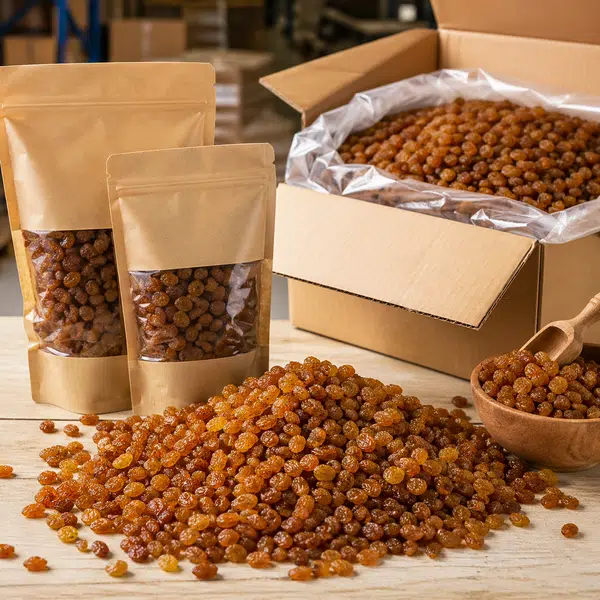
Sultana raisins are one of the most flexible dried fruit categories in international trade, but private label and bulk export require very different commercial structures.
Turkish sultana raisins are used across a wide range of channels, from mass retail and premium snack packs to industrial bakery, cereal, confectionery and foodservice. That versatility is commercially attractive because one raw product family can serve several market segments. At the same time, it means buyers need to separate two very different supply models early in the discussion: finished consumer-facing private label supply and bulk export supply for repackers, distributors or manufacturers.
Private label and bulk export are not simply two packaging choices. They affect the full commercial structure of the program. Private label usually requires more work on branding, retail pack design, legal label review, barcode management, case counts, launch timing and replenishment planning. Bulk export is often more flexible on presentation, but more dependent on freight efficiency, downstream handling capability, warehouse discipline and the buyer's ability to repack or redistribute effectively at destination.
Because sultana raisins are available in many grades, sizes, cleaning standards and pack options, the correct commercial route depends on the intended market. A supermarket private label range will usually need a different pack format, specification discipline and documentation set than a bulk ingredient program for an industrial bakery group or a distributor serving multiple countries. Buyers who define the model clearly from the beginning tend to receive more accurate offers and fewer revisions later.
For that reason, this topic deserves a dedicated article. The right question is not whether private label is better than bulk export in general. The right question is which route best fits the buyer's channel, operational capabilities, risk tolerance, forecast visibility and target margin structure. Once that is clear, specification, packaging and quotation become much more efficient.
These points help importers, distributors and brand teams choose the right supply model faster.
Retail-ready supply typically requires clearer SKU planning, packaging decisions, artwork approval, compliance review and ongoing replenishment discipline.
Bulk programs usually work well for buyers who want local repacking, multi-market allocation, industrial use or stronger control over destination-side distribution.
The right raisin grade depends on whether the product is being sold directly to the consumer, blended into food manufacture or repacked after import.
A lower headline offer is not always the better choice if it creates operational limits, documentation gaps or less suitable packaging for the target market.
Most sultana raisin programs can be grouped into one of these two structures, even when a buyer eventually uses both.
This route is built around finished retail or channel-ready packaging under the buyer's brand or a retailer's own label. It usually includes defined SKU sizes, barcodes, approved artwork, fixed case pack logic and a tighter launch or replenishment calendar.
This route is designed for importers, industrial users, repackers, foodservice operators and distributors that buy larger export packs and manage final packaging or channel allocation later in the chain.
Some buyers combine both. For example, a distributor may import bulk sultanas for flexible resale and repacking while simultaneously running a small private label retail program for selected customers. In those cases, the commercial discussion should clearly separate the volumes, specifications and packing logic for each route.
Private label is usually stronger when the value of finished presentation, brand ownership and retail control is higher than the need for flexibility.
These customers usually need fixed consumer pack sizes, barcode accuracy, label compliance and reliable replenishment under a defined retail brand structure.
Where the buyer wants direct consumer recognition, consistent shelf identity and a clear product story, private label or branded packing is often the better route.
These channels often place importance on visual presentation, claims, packaging design and a consistent premium market position.
Private label works well when the buyer already knows the pack sizes, channels and likely replenishment pattern in advance.
New product launches often benefit from an integrated pack-and-product project rather than a later conversion from bulk supply.
Where finished pack appearance and shelf-ready execution influence sell-through, private label can justify the extra preparation involved.
Bulk export is usually stronger when the buyer wants operational flexibility, local market adaptation or industrial efficiency.
Importers that pack closer to the destination market can adapt pack sizes, language panels and customer-specific formats without locking all volume into one origin-packed SKU.
Bulk export allows the same shipment to support several countries or customer groups with different labeling and channel requirements.
For manufacturers, consumer-facing packaging is usually unnecessary, so bulk supply is often the more efficient commercial route.
Large users and distributors may prefer larger pack formats that reduce packaging complexity and improve cost efficiency per usable kilogram.
Bulk stock can often be redirected more easily between customers and market segments than finished private label inventory.
Where custom print and retail presentation are not essential, bulk export can reduce planning pressure and simplify the route to shipment.
The same raisin category can serve both routes, but the most suitable grade is not always identical.
Retail-facing programs often require more controlled appearance, stronger uniformity, lower visible defect tolerance and a cleaner presentation that supports the finished pack image.
Bulk programs may still require high quality, but they can often use a more practical commercial specification aligned to further processing, repacking or industrial application.
Selected grades, tighter cleaning or more controlled appearance usually matter more in finished consumer packs than in industrial ingredient programs.
Both routes need product stability, but destination use will determine how tightly moisture and handling characteristics need to be defined.
Sultanas can support both organic and conventional programs, but the chosen route will influence how claims, documentation and market messaging are handled.
Private label and branded retail programs usually need tighter continuity from lot to lot, while some industrial channels may allow more commercial flexibility.
Private label programs require a pack-and-product workflow, not just a bulk fruit booking.
Private label programs generally require approval of product name, ingredients, nutritional panel, storage guidance, barcode and destination-specific legal text before production release.
Unit weights, pouch styles, case counts and sales channels should be defined early so packaging materials and production planning remain commercially efficient.
Printed material production usually needs forecast visibility, approval timing and a clear first-shipment plan to work smoothly.
Finished packs must also be supported by suitable master cartons, coding, pallet patterns and logistics planning for destination handling.
Private label often involves sample sign-off, artwork approval, commercial confirmation, production scheduling and replenishment planning in a defined order.
Once the launch is complete, ongoing availability depends on forecast accuracy, print-material management and shipment timing, not only on raw fruit stock.
Bulk export programs prioritize freight performance, pack protection and downstream handling flexibility.
Bulk programs usually rely on lined cartons or other export-ready formats that protect the raisins during transit and remain practical for industrial use or local repacking.
The packaging system should match transport duration, warehouse handling and the buyer's downstream operating model to avoid avoidable losses.
Bulk shipments are often more sensitive to pallet height, case dimensions, stacking stability and container utilization than retail-ready programs.
Buyers should ensure that their warehouse, repacking or processing system can handle the selected bulk format efficiently.
Bulk export often makes commercial sense when the buyer can convert stronger freight efficiency into downstream flexibility or local market advantage.
Bulk stock can often be reassigned more easily between customers or pack formats than finished retail packs if demand changes after arrival.
Both supply routes require documentation, but the content and commercial sensitivity are not the same.
Usually includes stronger label review, barcode control, artwork confirmation and retail-ready technical support in addition to standard product documents.
Often focuses more on product specification, packing details, shipment documents, traceability and any technical declarations required for import or industrial use.
Where organic sultanas are involved, both routes require consistency between product status, transaction documents, packaging language and market claims.
Private label buyers may need questionnaires, declarations or supplier approval files beyond the routine technical and shipment document set.
Bulk export may permit destination-side label adaptation, while private label usually fixes language and artwork earlier in the process.
Regardless of route, the product description, lot references, pack details and commercial paperwork should remain aligned throughout the file set.
Both models benefit from forecast visibility, but private label generally depends on it more heavily.
Because packaging materials, print runs and production slots are tied to defined SKUs, private label works best when the buyer can provide realistic demand visibility.
Bulk supply can absorb some demand variation more easily because final pack decisions are often made later in the chain.
Very small or fragmented demand may be more practical in bulk format, while stronger recurring volume may justify a more structured private label program.
Sultana raisins are tied to the crop cycle, so both private label and bulk programs should align with harvest timing, stock readiness and annual shipment planning.
A supermarket launch, a bakery distributor and an industrial user each need different stock planning logic even if they all buy sultanas.
Monthly, quarterly or campaign-based supply affects packaging, inventory and freight planning differently for each commercial route.
The better option depends on where the buyer wants complexity, flexibility and value to sit in the chain.
Finished retail presentation, stronger brand control, defined shelf identity, easier direct consumer positioning and a more complete market-ready product.
Higher flexibility, easier local repacking, multi-market adaptation, simpler packaging flow and better potential for destination-side inventory allocation.
Longer lead times, more approvals, less flexibility after packaging is fixed and greater dependence on accurate forecasting.
More work may shift to the importer or distributor, and the buyer must have the local capability to repack, relabel or channel the product effectively.
In simple terms, private label moves more of the work upstream before shipment, while bulk export keeps more flexibility downstream after import. The better model is the one that fits the buyer's actual operating system, sales channel and inventory strategy.
Most preventable problems come from choosing the route too late or without enough commercial clarity.
Custom packaging and production planning become inefficient when the buyer cannot define realistic launch or replenishment volumes.
Bulk export only creates value when the buyer can manage repacking, redistribution or industrial handling effectively after arrival.
The two routes carry different cost structures, service levels and operational risks, so quotations should be compared within the correct model.
Pack format affects freight, inventory logic, launch timing and customer acceptance, so it should be part of the early commercial brief.
A structured inquiry helps buyers and suppliers move faster toward the right supply model and a more accurate quotation.
Confirm grade, appearance expectations, certification profile, target channel and whether the raisins are for direct retail sale or downstream use.
State clearly whether the requirement is private label, bulk export or a combination of both so the supplier can structure the offer correctly.
Share unit size, bulk pack type, carton style, pallet preference and whether custom printing or label approval is required.
Clarify destination market, retailer or industrial channel, language needs and whether the program is organic or conventional.
Provide trial volume, likely repeat order size and annual demand estimate so production and stock planning can be matched to real business potential.
For private label, share expected first-delivery timing, artwork status, approval milestones and replenishment expectations as early as possible.
Atlas treats private label and bulk export as two distinct supply models that require different execution logic, not just different pack sizes.
Atlas Global Trading Co. supports sultana raisin buyers by helping define the correct route to market before the quotation process becomes too narrow. That means separating private label requirements from bulk-export requirements, aligning grade and cleaning standard with the intended channel, reviewing packaging and compliance implications and building the discussion around realistic shipment and replenishment planning. This approach usually produces better commercial clarity than a simple price-per-kilogram comparison because it reduces hidden assumptions and improves execution fit.
For retail and branded buyers, Atlas can help structure the conversation around consumer pack presentation, label review, case logic and replenishment. For importers, industrial users and distributors, Atlas can help frame the program around bulk packaging, freight efficiency, downstream flexibility and annual supply continuity. In both cases, the objective is the same: create a sultana program that matches the buyer's real operating model and performs reliably in trade.
Short answers help buyers review the topic quickly before moving into quotation and program design.
End use, target market, desired grade, required certification profile, preferred pack format and whether the program is private label or bulk export should be clarified first.
Because private label and bulk export programs require different planning for grade selection, packaging, labeling, documentation, inventory, logistics and commercial execution.
In many cases yes, provided the fruit, certification profile, packaging structure and market requirements are aligned with the customer requirement and the available sourcing program.
Private label usually involves consumer-ready packaging, artwork, barcodes, label review and launch planning, while bulk export is more focused on cost efficiency, flexible downstream repacking, freight performance and industrial or distributor handling.
No. The better route depends on the buyer's sales model, local handling capability, forecast quality, customer structure and desired level of market control.
Yes. Some buyers combine retail-ready private label SKUs for fixed accounts with bulk export volumes for flexible local repacking or industrial distribution.