Size profile
Buyers often expect some degree of size consistency because it affects pack presentation, dosing, product appearance and downstream handling.
A practical commercial guide to how buyers evaluate Malatya sun-dried apricot grades, size expectations and quality parameters for retail, industrial, bulk and private label programs.
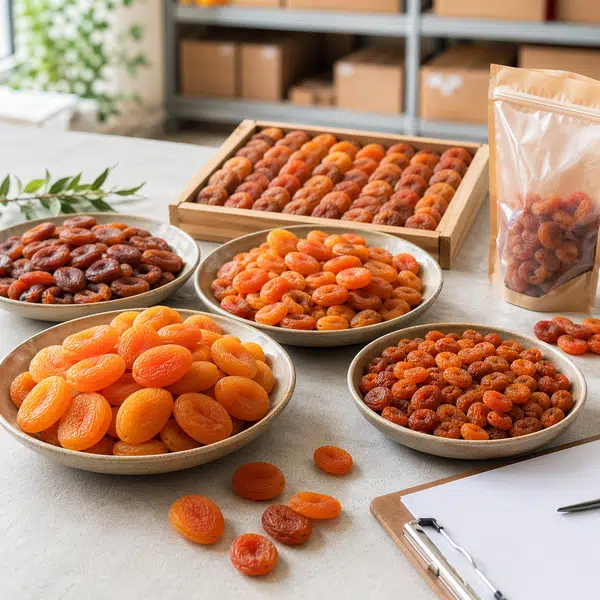
In sun-dried apricot trade, buyers usually cannot compare offers properly unless they first understand what the grade and size description actually means in commercial terms.
Malatya-origin sun-dried apricots are one of Turkey's most important dried fruit categories and are sold into premium retail, industrial ingredient, foodservice, private label and bulk distribution channels. Although the product name may be the same across these channels, the required grade profile is often different. One buyer may need strong visual presentation and tighter size harmony for consumer-facing packs, while another may need a more practical industrial grade that prioritizes functional suitability over retail-style appearance.
That is why grades, sizes and quality parameters are more than descriptive terms. They are part of the commercial structure of the offer. They influence price benchmarking, suitability for the target application, packaging choices, repeatability across shipments and how the product will actually perform in the buyer's business model. A strong buying conversation therefore starts not with a general request for apricots, but with a specification that reflects the intended use.
Buyers also need to understand that grade is not always the same as overall quality. A lower-cost industrial grade may still be fully suitable for a manufacturing application, while a more presentation-controlled grade may be the right choice for premium retail or private label packs. The important question is not simply whether one grade is better than another, but whether it is better for the intended channel.
Atlas separates this topic because grade language often creates unnecessary confusion in international trade. A clearer explanation of size logic, visible quality expectations and channel fit usually leads to better offers, better samples and fewer mismatches between expectation and delivered shipment.
In commercial practice, grade is usually a combined expression of size profile, visible appearance, selection level and suitability for a specific channel or application.
Buyers often expect some degree of size consistency because it affects pack presentation, dosing, product appearance and downstream handling.
Visible quality expectations usually include shape harmony, overall presentation and the degree of acceptable natural variation.
Some grades involve tighter sorting and stronger presentation control, while others are structured for broader industrial suitability.
The same apricot may be suitable for one channel and less suitable for another, even when the fruit is commercially sound.
Retail, private label, bulk and industrial buyers usually interpret grade through the needs of their own route to market.
For recurring programs, a grade also needs to be stable enough that the buyer can benchmark future shipments against the same baseline.
Size is not only a visual preference. It influences presentation, pack efficiency, industrial usability and how the product is perceived at destination.
In premium retail and private label channels, size often matters because it shapes the visual balance inside the pack and supports a more consistent consumer impression. In bulk and foodservice channels, size may influence handling practicality, repacking efficiency or the appearance of the product when it is later redistributed. In industrial applications, size can affect cutting, blending, dosing or other processing steps depending on how the fruit will be used.
That is why buyers should not treat size only as a cosmetic issue. A size profile that works well in one commercial route may be inefficient or unnecessarily expensive in another. The most useful size brief is the one that reflects the real application rather than a general preference copied from a different channel.
Most commercial specifications are built around a manageable group of visible and practical quality parameters rather than a vague description of good quality.
Buyers often want a reasonably stable size profile because it supports more predictable presentation and product handling.
Shape, general visual harmony and the level of acceptable natural irregularity usually matter more in retail-facing channels.
The fruit should be suitable for the intended route to market, whether that is direct retail sale, repacking or industrial use.
Sun-dried apricots are valued for a natural sweetness-acidity balance, and the intended channel may influence how strongly that profile matters.
All dried fruit categories include some natural variation, so the important question is how much variation is commercially acceptable for the intended program.
The final test of quality is whether the product profile supports the buyer's actual sales or production model, not only whether it looks strong in isolation.
A single universal grade standard rarely works across every commercial route. The right grade depends on where the apricot is going next.
These typically place greater importance on pack appearance, visual consistency and a stronger presentation standard.
These often need stable repeatability because the brand presentation must remain aligned across multiple shipments.
These generally focus more on commercial practicality, downstream flexibility and sensible grade fit for the destination market.
These buyers usually assess the apricot more through functional suitability than through premium whole-fruit retail presentation.
The same product name may therefore sit in very different commercial frameworks. This is why a supplier conversation becomes much more effective when the buyer explains the actual route to market before asking for a final price comparison.
Pricing differences often come from the level of size control, visual selection and channel suitability expected in the final specification.
Buyers often see price differences between apricot offers and assume they reflect margin alone. In practice, the price gap may come from tighter size selection, stronger visual sorting, channel-specific requirements or packaging structures linked to the intended program. A more presentation-controlled grade can carry a different commercial structure than an industrial or bulk-oriented grade, even when both are based on the same crop and origin.
This is why grades should never be benchmarked without reference to the target application. A strong industrial grade may be the right and most economical choice for a manufacturer, while a higher-presentation grade may be the correct choice for premium retail. The price only makes sense when the grade logic is understood first.
The most useful inquiry is one that connects grade expectations directly to the business model and application.
Retail, private label, repacking, foodservice and industrial use each imply different quality and size priorities.
Instead of asking only for a good grade, explain whether the priority is premium presentation, practical distribution quality or industrial suitability.
The correct grade may depend on whether the fruit is sold in a consumer pouch, a foodservice pack, a carton for redistribution or an industrial ingredient pack.
If the apricot is for blending, cutting, repacking or direct shelf sale, that information helps shape the most relevant grade offer.
In dried fruit trade, the best commercial result often comes from defining acceptable natural variation clearly rather than demanding unrealistic uniformity.
Sampling and quotation work best when both are tied to the same commercial grade description and channel logic.
Most confusion comes from vague language or from comparing specifications designed for different channels.
Requests such as premium grade or best quality are too broad unless tied to a channel, size expectation and pack format.
A grade suitable for industrial use should not be judged by the same presentation logic as a premium retail shelf program.
Two apricot quotations are not directly comparable when they reflect different size control, different selection logic or different packing scope.
All dried fruits have some natural variability, so the more useful question is what level of variation remains commercially acceptable.
When the buyer shifts the size or appearance expectation after sampling or quotation, commercial alignment usually becomes weaker.
For recurring purchases, grade needs should be stable enough that future shipments can be benchmarked against the same baseline.
For recurring supply, grade and size logic should be part of the annual program rather than renegotiated from zero each time.
Annual buyers usually perform better when they define the accepted grade profile early and use it as a repeat purchasing baseline. This helps them compare samples, quotations and shipments more reliably over time. It also helps suppliers understand which product profile needs to be maintained across recurring deliveries.
Where a buyer runs multiple channels, the strongest approach is often to separate the grades by commercial route rather than trying to force one universal profile into every pack format or market segment. A premium private label pouch, a bulk redistribution carton and an industrial bakery input may all come from the same origin, but they rarely belong under exactly the same grade description.
A strong specification conversation should connect size and quality expectations directly to the real program.
State whether the apricots are for retail, private label, bulk distribution, foodservice or industrial use, because grade logic changes by channel.
Describe the desired size profile, visible quality expectation, acceptable natural variation and whether presentation or functional suitability is the main priority.
Share the expected pack format, annual volume direction and whether the inquiry is for a one-off shipment, a trial or a recurring program baseline.
These are the main points serious buyers usually need before benchmarking sun-dried apricot grades and sizes.
It usually reflects size profile, appearance level, selection intensity and suitability for a defined sales or production channel.
Size influences pack presentation, handling, industrial function and downstream market fit, not only visual preference.
A premium retail program, a private label pack and an industrial ingredient model should not automatically use the same grade logic.
Once the buyer defines the channel, pack format, size expectation and acceptable variation, suppliers can structure much more useful offers.
Short answers for importers, distributors, industrial users and private label buyers reviewing sun-dried apricot specifications.
Buyers should clarify end use, target market, desired grade, sulfur-free or other quality profile, required certification scope and preferred pack format before requesting a quotation.
Because buyers cannot benchmark offers accurately unless they understand the logic behind grade, size, visible quality expectations and the commercial suitability of the fruit for the intended channel.
The main priorities are end use, size consistency, appearance expectations, workable texture, acceptable natural variation and whether the grade profile matches the intended industrial, retail, bulk or private label application.
In many cases yes, provided the fruit profile, certification requirement, grade logic and packaging structure are aligned with the customer requirement and the available sourcing program.