Muesli and cereal blends
Sun-dried apricot pieces can add fruit contrast, chew and natural sweetness-acidity balance in dry breakfast blends.
A practical commercial guide to how Malatya sun-dried apricots are used in breakfast cereals, granola, snack mixes and fruit-based blends, covering ingredient behavior, industrial formats and sourcing considerations.
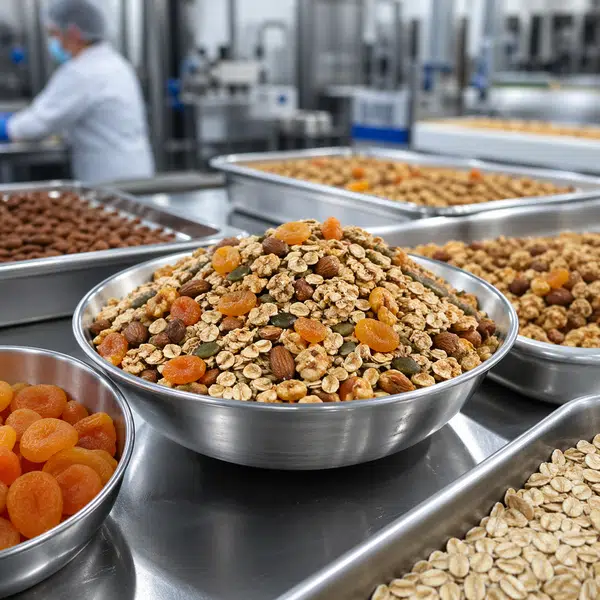
Sun-dried apricots are highly relevant in breakfast and snack categories because they combine recognizable fruit identity, natural sweetness and chew with strong visual appeal in dry blends.
Malatya-origin sun-dried apricots are one of Turkey's most commercially important dried fruit products and are used across retail, private label, bakery, confectionery and industrial ingredient channels. In breakfast cereals, granolas, muesli blends and snack mixes, they are valued for more than simple fruit content. They contribute visible fruit presence, a naturally sweet-tart note, soft chew and a premium dried-fruit character that works well with grains, nuts, seeds and other inclusions.
However, breakfast and snack mix applications have their own ingredient logic. Manufacturers in these categories usually focus on how the apricot behaves in blending, how well it disperses through the mix, whether the cut size remains commercially acceptable, how the fruit interacts with dry ingredients and whether the resulting product remains visually attractive and easy to portion. These are not the same priorities found in whole-fruit retail packs or even in confectionery applications.
That is why buyers usually need a more specific discussion than simply asking for sun-dried apricots in bulk. They need to define whether the product is intended for granola, muesli, cereal clusters, snack trail mixes, fruit and nut blends or hybrid breakfast-snacking formats. They also need to consider whether the ingredient should be used as a visible larger inclusion, a more controlled diced format or part of a broader fruit mix component.
Atlas treats breakfast and snack mixes as a dedicated industrial application because the sourcing decision should be based on product behavior in the blend, not just on general fruit specification. Once the application is clear, the supplier can structure a much more useful offer around cut format, quality profile, pack format and annual demand logic.
The ingredient is flexible across both traditional breakfast categories and modern snack concepts that combine fruit with grains, nuts and seeds.
Sun-dried apricot pieces can add fruit contrast, chew and natural sweetness-acidity balance in dry breakfast blends.
They are used where visible fruit identity and a premium dried-fruit impression support the positioning of the finished product.
Apricots can serve as a soft, fruity counterpoint to nuts, seeds and more crunchy inclusions in savory-sweet or sweet snack concepts.
They fit well into fruit-forward snack mixes that emphasize recognizable ingredients and natural fruit presence.
Apricot pieces may support premium cereal cluster or breakfast-snack concepts where dried fruit visibility is commercially important.
Sun-dried apricots are also relevant in crossover formats that sit between breakfast, snacking and fruit-nut convenience mixes.
In breakfast and snack applications, the ingredient must work well in the blend and remain commercially attractive throughout packing and shelf life.
The apricot format should suit the target mix style, whether the goal is a visible fruit piece or a more evenly distributed small inclusion.
Manufacturers usually want fruit that provides a pleasant chew without creating handling difficulty or an imbalanced mouthfeel in the final product.
The ingredient should work coherently with grains, nuts, seeds, flakes and other inclusions rather than dominating or weakening the mix structure.
Visible fruit pieces often support product value perception, especially in premium granola and fruit-and-nut formats.
Sun-dried apricots contribute sweetness with mild acidity, and that balance should fit the intended positioning of the breakfast or snack product.
The pack format and inclusion profile should support efficient receiving, storage and line-side use in industrial blending environments.
The correct apricot specification depends on how the product is intended to appear and behave inside the final breakfast or snack mix.
Not every breakfast or snack manufacturer needs the same ingredient form. Some premium granola or muesli products work best with larger visible fruit pieces that give the blend a stronger natural and artisanal impression. Other applications need smaller diced or cut formats that disperse more evenly, support portion consistency and reduce the chance of uneven fruit concentration in the pack. Still others may require a standardized industrial inclusion format for high-volume automated blending.
Because of this, the buying brief should define the role of the apricot in the finished mix. Is it intended to be a hero ingredient, a supporting fruit element, a source of chew, a color contrast or one component in a fruit-and-nut blend? The answer changes the most useful commercial offer. A visible inclusion format, for example, may place greater emphasis on appearance and piece integrity, while a smaller mix-oriented format may place greater emphasis on consistency and industrial flow behavior.
The best ingredient profile is the one that supports the intended blend, not necessarily the one optimized for another channel such as whole-fruit retail.
Breakfast and snack manufacturers usually want fruit that works in dry mixes without creating avoidable handling or balance issues.
Where the apricot appears as a visible inclusion, reasonably consistent cut form usually supports better blend appearance and pack uniformity.
The fruit should add a pleasant soft bite without feeling too dominant relative to grains, nuts or crispy elements in the mix.
Industrial users often accept a different visual logic than retail buyers, provided the ingredient remains commercially fit for the application.
The apricot should complement the overall recipe profile, particularly where the finished mix includes sweet, nutty or toasted components.
Recurring production programs normally need a stable ingredient profile so product developers and factories do not need repeated adjustment work.
Breakfast and snack manufacturers usually buy sun-dried apricots as a functional inclusion, not as a finished consumer dried-fruit product.
Retail fruit packs generally emphasize whole-fruit presentation, visual consistency and finished consumer appeal. Breakfast and snack mix users are usually more focused on inclusion fit, cut format, blending behavior, pack handling and how the apricot interacts with the rest of the formula. That means a product ideal for premium retail shelf presentation may not always be the most efficient option for industrial mixing, and vice versa.
This distinction is commercially important because it changes how buyers should brief suppliers. A breakfast or snack mix inquiry should usually prioritize application role, cut size, pack format, annual volume and desired blend performance rather than relying only on a general dried-fruit grade request. Once the supplier understands the industrial use case, the quotation becomes more relevant and easier to benchmark.
These applications usually require factory-friendly packing rather than consumer-ready presentation.
Most industrial breakfast and snack programs are supplied in bulk-oriented formats suitable for warehouse storage and controlled release into blending operations.
The pack should support easy opening, handling and transfer in the production environment without unnecessary labor or disruption.
For regular industrial volumes, pallet logic and storage practicality matter because they influence internal handling and landed cost efficiency.
Clear lot identification is normally important for factory control, internal QA routines and repeat purchasing consistency.
The strongest sourcing discussions begin with the product concept and inclusion role, not only with a target price.
To build a reliable breakfast or snack mix program, buyers normally need to explain how the apricot functions in the final product. Is it a prominent fruit component in a premium granola? Is it part of a fruit-and-nut mix? Is it a support ingredient in a cereal blend where even distribution matters more than strong visual dominance? These questions help define the correct format and quality logic.
Once the application is clear, the supplier discussion can move to cut style, industrial pack format, volume range, certification scope and whether the project is at development, trial or recurring annual production stage. This approach usually produces a more useful quotation and lowers the risk of buying an ingredient that appears acceptable in theory but performs weakly in commercial production.
Most problems occur when buyers use a general dried-fruit brief instead of an application-specific industrial brief.
Asking for sun-dried apricots without defining whether the fruit should be visible, supportive, large-cut or mix-distributed weakens the quotation quality.
Whole-fruit retail presentation standards may not reflect the most relevant quality logic for cereal or snack mix manufacturing.
An apricot may be attractive in isolation but still inefficient if it does not suit the blend structure or target pack appearance.
The ingredient may be technically acceptable but still operationally weak if the industrial pack is not suited to the receiving and blending environment.
The lowest offer may not be the most economical once piece consistency, factory usability and repeatability are taken into account.
Without at least an estimated annual demand range, suppliers can only respond tactically instead of building a more stable industrial program.
A strong breakfast or snack mix inquiry should define the industrial use clearly enough that the quotation reflects the true requirement.
State whether the apricot is for granola, muesli, cereal blends, fruit-and-nut mixes, cluster snacks or another breakfast-snacking format, and explain its role in the mix.
Confirm cut format, target texture, sulfur-free or other quality profile, desired visual effect and whether piece visibility or uniform distribution is the main priority.
Share expected volume, industrial pack requirement, certification scope and whether the inquiry is for product development, trial runs or recurring annual production.
These are the main points breakfast and snack mix buyers usually need before sourcing sun-dried apricots as an industrial inclusion.
Sun-dried apricots should be sourced according to how they function in the blend, not only as a general dried-fruit commodity.
Larger visible pieces, smaller diced formats and more standardized industrial inclusions can lead to different technical and commercial outcomes.
The best breakfast or snack mix ingredient is the one that blends, handles and performs well in production, not necessarily the one optimized for consumer whole-fruit retail packs.
Once the application, format, pack structure and demand profile are defined, the supplier can offer a more precise and commercially useful industrial program.
Short answers for cereal manufacturers, granola producers, snack mix brands and ingredient buyers reviewing sun-dried apricot applications.
Buyers should clarify end use, target market, desired grade, sulfur-free or other quality profile, required certification scope and preferred pack format before requesting a quotation.
Because breakfast and snack mix applications have their own technical expectations. Manufacturers usually assess apricots by cut size, chew, inclusion stability, sweetness-acidity balance, flow behavior and compatibility with cereals, nuts, seeds and other dry ingredients.
The main priorities are application fit, suitable texture, manageable moisture, consistent cut format, visual presence, flavor balance and whether the ingredient performs reliably in blending, filling and shelf-life planning.
In many cases yes, provided the fruit profile, certification requirement, cut format and industrial packing structure are aligned with the customer requirement and the available sourcing program.