Consumer-facing presentation
The product must support the visual and commercial expectations of the final retail brand, not only basic export acceptance.
A practical commercial guide to private label and bulk export structures for Malatya sun-dried apricots, covering product fit, consumer pack strategy, bulk shipment logic, documentation, labeling and annual supply planning.
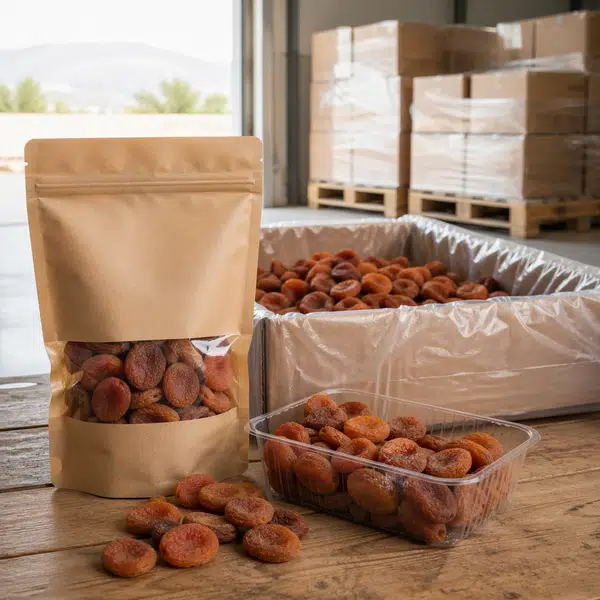
Sun-dried apricots can be sold through very different channels, and the right export structure depends heavily on whether the buyer is building a private label line or a bulk trade program.
Malatya-origin sun-dried apricots are one of Turkey's most commercially important dried fruit categories and can serve premium retail, private label, foodservice, industrial ingredient and wholesale distribution channels at the same time. Because these channels use the product differently, buyers usually need more than a simple product offer. They need a commercial structure that fits the route to market.
Private label programs typically focus on shelf presentation, consumer pack consistency, label approval, barcode structure, market-specific claims, traceability and repeatability across multiple shipments. Bulk export programs usually focus more on pack efficiency, transport logic, repacking flexibility, industrial suitability, distribution flow and commercial practicality at destination. The fruit may come from the same origin, but the business model around it is different.
This difference affects how quotations should be compared. A retail-ready private label offer includes more than the apricot itself. It may involve consumer packaging, printed materials, tighter appearance control and stronger documentation alignment. A bulk export offer, by contrast, may be structured around larger pack units, simpler outer case logic and efficient movement into local repacking or industrial use. Treating these two routes as if they were directly interchangeable often leads to weak comparisons and unnecessary confusion.
Atlas separates private label and bulk export considerations because buyers need to define the commercial route before they can define the right product, pack format and shipment logic. Once that route is clear, the offer becomes much more precise and much more useful.
Private label sun-dried apricot programs are built around consumer presentation, market-facing compliance and repeat shelf consistency rather than only around bulk fruit movement.
The product must support the visual and commercial expectations of the final retail brand, not only basic export acceptance.
Private label projects usually require earlier approval of label content, language, barcode structure and market-facing design details.
Consumer units, outer cartons and pallet logic should remain stable from shipment to shipment because retailers value repeatability.
Private label buyers often expect stronger consistency in visible presentation because the brand is carried directly on the pack.
Samples, labels, pack formats and documentation are often reviewed together before the program is released into full shipment flow.
The project usually requires more front-end planning than bulk export because packaging and retail readiness must be aligned before dispatch.
Bulk export programs are usually designed around efficient movement, local flexibility and downstream handling rather than direct consumer shelf readiness.
Many bulk buyers intend to repack the apricots at destination, so the priority is often efficient inbound product structure rather than finished retail presentation.
Bulk exports may feed local distribution, foodservice, repackers or industrial users, each of which values operational practicality more than shelf packaging.
Bulk programs usually emphasize freight efficiency, warehouse handling and container logic because those factors shape landed commercial performance.
Because the product may be packed again later, the original export structure is often simpler than in a private label consumer-ready program.
Bulk export does not mean low-value trade. In many cases it is simply a different commercial route. A serious repacker or industrial buyer may have strong quality expectations, but those expectations are expressed through specification, grade, handling suitability and document discipline rather than through a finished consumer pack at origin.
The right route depends on who controls the final consumer offer, where the product will be packed and how much flexibility the buyer wants at destination.
Private label is usually the better route when the buyer wants finished consumer packs ready for branded retail distribution.
Bulk often makes more sense when the importer wants to repack, relabel, blend, distribute or process the product after arrival.
The buyer's warehousing, repacking capability, labeling system and customer model should guide the export structure, not only the product itself.
Private label projects often need longer preparation, while bulk programs may provide more flexibility when faster market entry is required.
In private label, more pack-level compliance is normally fixed at origin; in bulk, more market adaptation may happen at destination.
The commercial logic differs depending on whether value is added through a finished retail pack or through destination-side repacking and channel development.
Private label and bulk routes may use the same apricot origin, but they do not always require the same product profile or selection logic.
Private label buyers often prioritize appearance consistency, pack-ready presentation and a grade structure that supports the intended retail positioning of the final consumer unit. Bulk buyers may be equally demanding in quality, but they tend to judge the product more through commercial suitability for repacking, ingredient use or distribution rather than purely through shelf-facing presentation.
This is why product briefing must precede price comparison. A consumer-facing, higher-presentation private label program and a large-volume bulk repacking program should not be benchmarked as if they represented the same offer. Even when the fruit comes from the same region and harvest period, the export structure changes the commercial expectation around grade, packing and execution.
Private label packaging is not just a transport medium. It is part of the finished commercial product.
The retail pack size, format and visual structure should match the price point, shelf strategy and target consumer segment of the brand.
Pack content, legal text, barcode logic and branding details need to be finalized early enough to avoid delays during execution.
Even when the inner pack is consumer-ready, the export carton still needs to protect the shelf-ready product through loading and transit.
Stable pallet and carton structure help maintain retail pack integrity and support predictable receiving at destination.
Bulk packaging is usually chosen for movement efficiency, product protection and local flexibility rather than direct consumer presentation.
The pack should fit the buyer's warehouse, repacking or industrial handling system so that the imported product remains practical after arrival.
Carton structure matters because the product may move through port handling, warehousing and local redistribution before its final conversion.
Bulk programs usually need clear lot and shipment identification even where consumer-facing label design is not required at origin.
A good bulk structure should support later repacking, sorting, redistribution or industrial release without unnecessary handling inefficiency.
The documentation burden is not identical in private label and bulk trade, even when both involve the same fruit category.
Private label programs usually require stronger alignment between pack-level information, labels, claims, barcodes, documentation references and customer approval routines. This is because the product reaches the market as a finished consumer unit. Bulk programs may have less retail-facing label complexity at origin, but they still need clear export documentation, lot traceability and sufficient supporting information for customs, receiving and downstream handling.
In both routes, good documentation is commercially important. The difference is where the pressure sits. In private label, the pressure is often on consumer-ready accuracy and brand consistency. In bulk, the pressure is more often on clean export flow, traceability and operational usability at destination.
Both routes depend on crop timing, but the planning pressure appears at different points in the commercial process.
Because consumer units, labels and approvals take time, private label buyers usually need to engage earlier in the season than purely spot-oriented bulk traders.
Bulk buyers often have more room to adapt the market offer later because destination-side repacking remains available.
Neither route is independent from seasonality. Grade mix, pack timing and shipment scheduling are all shaped by the crop cycle.
Most project friction comes from using the wrong commercial structure for the route to market, not from the apricots alone.
These routes carry different packaging, approval and execution costs, so they are rarely directly comparable on price alone.
Private label projects often slow down when consumer unit, artwork and label structure are not fixed early enough.
Some buyers choose bulk for cost reasons even though they actually need a finished, presentation-controlled retail solution.
In some cases, buyers overcomplicate the origin program even though their true advantage lies in destination-side repacking and local market adaptation.
Problems arise when it is unclear whether origin or destination is responsible for final consumer labeling, claims and local pack adaptation.
Without a forecast or recurring structure, suppliers can only respond tactically, which weakens continuity in both private label and bulk export models.
A strong inquiry should define the export route first, then the product and pack structure that supports it.
State clearly whether the inquiry is for private label retail, consumer-ready export, bulk trade, destination repacking, wholesale distribution or industrial use.
Confirm grade, sulfur-free or other quality profile, target pack style, carton expectations, label needs and whether the product is finished at origin or at destination.
Share annual volume estimate, target market, shipment rhythm, certification requirement and whether the inquiry is for a launch, trial or ongoing annual program.
These are the main points buyers usually need before structuring serious private label or bulk export programs for sun-dried apricots.
Private label focuses on finished consumer presentation and pack compliance, while bulk focuses more on efficient movement, repacking flexibility and operational handling.
Offers become meaningful only when the buyer first decides whether value will be added at origin through retail-ready packing or at destination through bulk conversion.
Consumer-facing and bulk trade programs may use similar fruit, but they do not use the same packing, labeling or approval structure.
Whether private label or bulk, buyers usually achieve better continuity when they share a forecast, fix the program logic early and align the shipment structure with the crop cycle.
Short answers for importers, retailers, repackers and industrial buyers reviewing sun-dried apricot export structures.
Buyers should clarify end use, target market, desired grade, sulfur-free or other quality profile, required certification scope and preferred pack format before requesting a quotation.
Because private label and bulk export programs follow different commercial logic. Private label focuses more on consumer pack presentation, labels and repeat shelf consistency, while bulk export focuses more on efficient handling, repacking flexibility, carton structure and trade flow.
Private label programs are consumer-facing and require stronger control over packaging, labeling and product presentation, while bulk export programs are usually built around efficient transport, repacking options, industrial use or wholesale redistribution.
In many cases yes, provided the fruit profile, certification requirement, pack structure and channel-specific commercial expectations are aligned with the customer requirement and the available sourcing program.