Chocolate bars and slabs
Dates can be used as inclusions in molded or layered chocolate products where natural fruit sweetness and soft chew support a premium flavor profile.
A practical industrial and commercial guide to Tunisian dates in confectionery, including chocolate products, fruit centers, coated sweets, snack bars, date paste systems and premium sweet applications.
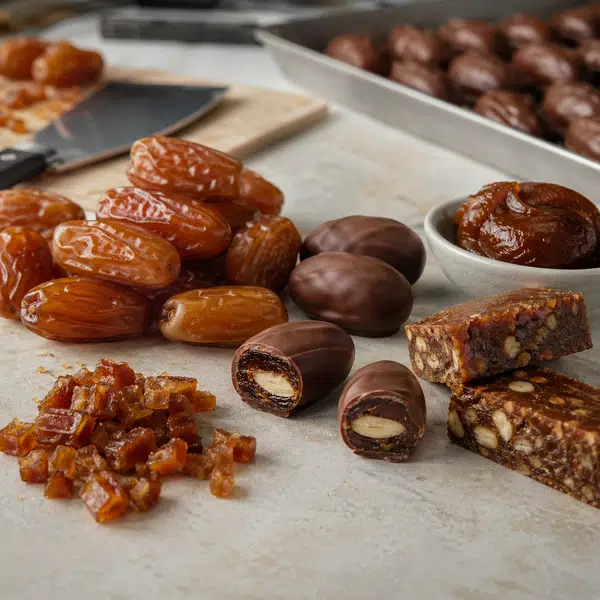
Confectionery buyers do not buy dates only as fruit. They buy sweetness, texture, structure, process compatibility and a commercial story that works in premium sweet products.
Tunisian dates, especially Deglet Nour, are highly relevant in confectionery because they combine natural sweetness, soft chew, appealing amber color and a recognized premium fruit identity. In industrial confectionery, they can be used in chocolate bars, fruit-and-nut clusters, soft-filled products, layered sweets, date-based centers, snack-confectionery hybrids and products positioned around natural sweetness or reduced reliance on refined sugar. This gives dates a broader role than many standard dried fruit inclusions.
From a product development perspective, dates can function in more than one way at the same time. They can appear as visible fruit pieces, act as a date paste base in fruit centers, contribute binding and softness in bars, or support premium texture in coated and filled sweet products. This makes them especially attractive for brands that want both ingredient recognition and formulation flexibility. However, it also means that date sourcing for confectionery needs more precision than a generic bulk fruit inquiry.
Commercially, confectionery programs are usually shaped by application fit. A buyer producing chocolate-coated premium bites may need visually clean, well-formed whole or chopped dates with controlled size and low unwanted breakage. A manufacturer producing filled products or fruit layers may care more about paste consistency, smoothness, sweetness balance and processing stability. A snack bar producer may prioritize softness, binding behavior and repeatable handling in line conditions. These are all date programs, but they are not the same product brief.
That is why confectionery sourcing should start with the process and the final format rather than with price per kilogram alone. Once the supplier understands whether the dates are for inclusions, paste, fruit centers, coated products or mixed sweet applications, the quotation can be structured on the right technical and commercial basis.
Industrial demand usually divides into several technical use cases, each with different expectations for format, texture and presentation.
Dates can be used as inclusions in molded or layered chocolate products where natural fruit sweetness and soft chew support a premium flavor profile.
Chopped or diced dates work well in premium clusters and bites where they help deliver texture contrast and a naturally sweet fruit identity.
Date paste or processed date preparations are relevant for soft-centered confectionery products that need a dense and naturally sweet fruit core.
Dates are widely suitable for bars positioned between confectionery and snacking, especially where binding, softness and natural sweetness are required in one ingredient system.
Whole or prepared dates can support chocolate-coated and compound-coated products where fruit character remains central to the finished item.
Tunisian dates can fit seasonal, festive and premium gift concepts where fruit appearance, origin identity and product storytelling add commercial value.
The right format depends on whether the product needs visible fruit, a soft fruit matrix or a process-friendly ingredient base.
Suitable for premium coated products, stuffed or filled confectionery concepts, and formats where whole fruit identity is part of the final product positioning.
Often preferred when the fruit will be further processed or used in applications where seed removal must already be built into the supply stage for efficiency and safety.
Useful for bars, clusters, mixed inclusion systems and confectionery formats that require more even fruit distribution and easier process integration.
Highly relevant for fruit centers, layers, binding systems and sweet products that need a dense fruit phase rather than visible whole or cut pieces.
Some industrial buyers may require specific particle size, paste behavior or handling profile depending on their depositing, mixing or forming line.
For regular manufacturers, date supply is often organized as a format-specific industrial program rather than as a general fruit purchase.
Confectionery applications expose weaknesses in date format and handling quickly, so technical suitability should be reviewed before recurring supply begins.
Texture is a major decision factor because confectionery products often depend on a precise balance between softness, bite and product stability.
The selected format should fit the manufacturing route, whether the product passes through cutting, mixing, depositing, coating, layering or forming equipment.
For chopped or diced dates, consistent size helps with distribution, visual control, portioning and finished product repeatability.
When dates are used as paste or in processed centers, spreadability, smoothness, density and handling stability become more important than whole-fruit appearance.
Tunisian dates are valued for a clean, sweet and recognizable profile, so batch-to-batch consistency matters in branded confectionery programs.
Most confectionery products are ready-to-eat, so buyers often require a clearly aligned food safety and microbiological profile suitable for their application and market.
One of the most commercially important confectionery uses for Tunisian dates is as a processed fruit base rather than as a visible fruit inclusion.
Date paste can play a central role in confectionery because it combines sweetness, density and natural fruit identity in one ingredient system. It is used in filled products, fruit layers, centers, molded items, snack-confectionery hybrid bars and other applications where the product developer wants a cohesive sweet mass rather than loose inclusions. In some concepts, date paste also helps improve product structure and reduce dependence on separate sweetening or binding components.
For buyers, the important point is that paste-grade sourcing is not the same as inclusion-grade sourcing. Once the dates will be processed into paste or supplied as an industrial date base, the discussion shifts toward consistency of texture, process behavior, smoothness, sweetness profile, handling performance and the requirements of the customer's own line. In this area, the right commercial decision often depends on functional suitability more than on whole-fruit visual grade.
Manufacturers should therefore clarify whether they need raw dates for in-house processing or a more prepared industrial format. This affects quotation logic, product scope, packing requirements and how the supply program should be structured over time.
Dates can work especially well in premium confectionery when the fruit remains visible or where natural sweetness is part of the brand story.
In chocolate systems and premium sweet applications, Tunisian dates are often chosen because they combine fruit recognition with a refined visual profile. Whole or prepared dates can support coated products, stuffed chocolate concepts, layered bars or mixed premium inclusions where fruit identity is commercially valuable. In these products, dates help create a more premium and ingredient-led proposition than a standard sugar-based sweet alone.
However, the product format must match the process. Whole dates may be appropriate where the fruit itself is central to the finished piece, but they are not always the right choice for automated mixed inclusion lines. Chopped or paste formats may perform better where portioning consistency, line speed and finished product uniformity are critical. This is why confectionery buyers usually gain more from application-specific quotations than from generic date offers.
Confectionery buyers usually assess more than supply availability. They assess the cost and reliability of turning the date ingredient into a repeatable finished product.
Manufacturers usually get better commercial results when the inquiry clearly states whether the dates are for inclusions, paste, coating products or filled items.
Annual or seasonal demand estimates help suppliers build a more stable program and improve continuity across repeat orders.
Whole, pitted, chopped and paste-grade dates should not be benchmarked as if they were the same commercial product.
The same origin may serve both premium retail confectionery and industrial processing, but the commercial expectations and value logic will differ.
Bulk pack structure, liners, pallet logic and operational labeling matter because they influence factory handling and storage efficiency.
Confectionery brands usually need stable ingredient behavior across multiple productions, so continuity matters as much as the first quotation.
Dates for confectionery need packaging that protects both product integrity and process usability after arrival.
Common for industrial buyers who need hygienic handling, warehouse practicality and repeatable inbound supply.
Whole fruit, chopped fruit and paste-oriented formats may each require different handling discipline depending on fragility, density or intended use after arrival.
Standardized pallet patterns, carton identification and lot control support smoother factory receiving and traceability.
For confectionery use, packaging should be matched to the industrial route. A format suitable for wholesale redistribution may not be the best option for a factory that feeds the product directly into production. Buyers should therefore align not only pack size but also warehouse handling logic, pallet preferences and production intake conditions when structuring a recurring date supply program.
Most industrial confectionery customers require a clear product approval framework before moving into regular purchasing.
The product brief should define format, pitted status if relevant, target appearance, texture expectations, pack structure and the intended confectionery use.
Because confectionery products are generally ready-to-eat, microbiological suitability and handling standards should be aligned with the final application and market.
Reliable lot identification supports quality assurance, complaint handling and customer approval systems in formal food manufacturing environments.
Organic and other customer-required documentation should be clarified early where the confectionery line depends on those claims.
Dates are often selected because they can contribute several functional and commercial advantages at once.
Dates help support confectionery concepts built around fruit-derived sweetness and ingredient recognition.
They can add softness, chew and density in bars, centers and mixed fruit sweet applications.
The same fruit origin can support whole, chopped and paste-based confectionery systems when the supply program is structured correctly.
Tunisian dates carry a recognized commercial identity that can strengthen premium confectionery storytelling in the right market context.
Most issues in confectionery date sourcing can be reduced by aligning the real application before price and shipment details are finalized.
Whole dates, chopped dates and date paste each perform differently, so the wrong format can create process inefficiency or finished product inconsistency.
When the supplier does not know whether the dates are for paste, inclusions or coated products, the resulting offer may not fit the real need.
A lower nominal offer may not deliver the same process fit, yield or finished product value as a format matched to the real confectionery application.
Delayed pack and handling alignment can weaken receiving efficiency and create avoidable operational friction at the factory.
Without recurring demand visibility, suppliers have less ability to structure a stable annual program for confectionery production.
Skipping clear technical approval can create issues in line behavior, filling performance, inclusion consistency or finished sensory profile.
A strong confectionery inquiry should make the process route and date format clear from the beginning.
Confirm whether the requirement is for whole dates, pitted dates, chopped dates, paste or another confectionery-specific format.
Share the intended use, target texture, size expectations, process route, food safety requirements and any line-specific handling concerns.
Clarify estimated volume, pack format, certification need, target market and whether the project is a trial, seasonal launch or recurring annual program.
These are the points that usually matter most for confectionery buyers evaluating Tunisian date supply.
Tunisian dates should be sourced according to whether they are needed for paste, inclusions, coated products or fruit centers, not as a generic fruit line.
Whole, pitted, chopped and paste-based date formats can behave very differently in confectionery production and should not be treated as interchangeable.
The right date format supports consistency in texture, process flow and finished product quality across multiple productions.
Forecast visibility and stable specification discipline generally produce better supply continuity than reactive spot buying for confectionery lines.
Short answers for importers, confectionery processors and product developers.
Buyers should clarify end use, target market, required format, whole or pitted requirement, desired grade, certification profile and preferred pack format before requesting a quotation.
Because confectionery applications require different product formats, process behavior, appearance standards and commercial conditions than bakery, retail snack or bulk distribution programs.
Whole dates, pitted dates, diced dates, chopped dates and date paste or date-based preparations are the most relevant formats depending on whether the product is a bar, fruit center, chocolate inclusion, coating application or soft confectionery item.
In many cases yes, provided the fruit profile, certification requirement, process route and packing structure are aligned with the customer requirement and the available sourcing program.